I love reading groups. I've professed that love before. Kids enjoy getting together with their peers to talk about virtually anything, books included. At the tail end of last week I had a few great experiences with my kids participating in their novel study groups.
The first instance involved a kid changing his mind about a book. I asked the group, "So what do you think of the book so far?" The reviews were largely mixed, and very tepid. That was until one of the kids said "I really like it now. It is like a mystery where your brain needs to solve the puzzle." This brought on a conversation where he was helping kids clarify some of the puzzle in the book "Chasing Vermeer." Everyone got into it, and was really invested in moving the conversation forward.
Later in the day I had some kids discussing the Phantom Tollbooth. They ran their group, which is difficult for a book where you are attempting to follow the myriad of plays on words. They were going over how Milo was going to get rhyme and reason back together, and escape many of the conundrums he found himself in. "Why didn't the 'Which' push the button to leave the dungeon?" bringing out a larger discussion about the meaning of "which" and the choices in the story.
The most difficult part of groups is trusting peers. You can talk about ideas, but trusting to put them on paper is tough. I had kids working on a problem solving and character analysis sheet, which they were to bring to their groups. It was interesting seeing kids reluctant to really discuss the rationale for why characters acted a particular way, or what actions said about a character. Some really took to it- "Holling standing up to the bullies show that he is maturing. Earlier in the story he would have complained about them, but now he is doing something. I bet it will help him stand up to his father.." Others really struggled in the discussion. It signals a need to keep building trust, as well as ways to converse with each other. It might also signal a need to really peel apart the layers of how characters act. How do character actions speak to who they are (or aren't)? That is what I want us to get at, and it is the hardest work done while reading.
Showing posts with label novel study. Show all posts
Showing posts with label novel study. Show all posts
Monday, May 14, 2012


Tuesday, February 28, 2012
Why I enjoy book groups...
Reading is a tough nut to crack. You can get it, or seem to get it, for a period of time before really missing the mark. In my experience you typically don't have that with some math skills- got dividing with remainders one day and then not the next. I will have kids that get it and then suddenly pop out the oddest of responses to questions.
"Getting it" is vital to book groups. When kids are responsible for coming prepared to a meeting the ante is raised. Moreover, the bar is set higher with a group of peers. No one wants to show up unprepared and stall out the group because they plowed through 60 pages without truly reading- word calling if you will.
I'm not sure what has done it, but my book groups are super. I've worked hard to get kids in high-interest books they have self-selected as ones they'd like to read. I put kids in groups that are not dominated by one voice, but definitely have someone who cares about reading. If need be, those are the kids leaned on to move conversation or push thinking further. The last thing is I've cut out lots of the writing kids pass in. It has steadily decreased over my first 2+ years. Instead, kids will stop and jot in journals daily with a smaller assignment once a week (2-3 over the course of a novel study). Kids have shown up well prepared, excited to talk, and willing to interact respectfully. You can't beat that.
Tuesday, February 21, 2012
Groups That Run Themselves
I'm trying something new for round two of literature circles/novel study. Instead of imposing page limits per week I'm going to turn control over to the book groups. Previously I'd assign 30-70 pages to be read over the course of the week. Some of that was during social studies and some of it was assigned as homework. This time is a little different.
I'm ceding control for a few reasons. The first is the length of this study. We are going to cruise through our books in 8-9 days. Instead of 2-3 weeks we are condensing it a bit, and more of the reading with happen in class. The second reason is because of how quickly they read. With some kids crushing, and understanding books in 2 days or less I needed to try something different. That leads me to my third and final reason...
I want kids to have more ownership over the process. They need to feel like a part of the process. It doesn't make a big difference if they are chapter 3 or 6 by the time they meet. They will all finish by the end of our schedule. But giving them a chance to decide as a team creates a bit more buy-in, and more ownership over the process. What I need to devote myself to is being sure to provide 15-30 minutes for 3 group meetings... Tough to cede valuable time, but it should be worth it.
Sunday, December 4, 2011
The Gap Between Recognition and Implementation
Perhaps the best part of my first year of teaching was getting to observe in the classrooms of far more experienced teachers. In particular, one visit was incredibly powerful. The class had been reading The True Confessions of Charlotte Doyle as a class novel/literature study. One of the things that they did was use Activotes ("clickers" if you will) to have students voice their opinion. From there students would offer why they made their choice, and debate their respective reasoning.
I walked away with a vision of my own. I wanted to kids to have discussions about books, but also to write about books. I also wanted to have them talking about ideas, and debating. What did I do? I modeled responses to literature ("What is one word to describe the character?", "What is the problem in the story and how do you think the main character will resolve it?") along with some basic criteria for "is it good enough." This gave students a baseline for whether the response that is at standard.
Since last year I've had kids scoring responses on a 4 through 1 scale. The point is to uncover "good enough" looks like. We'll look at a few different responses modeled after student work past and present, and score them. We did this last week and the discussions kids were having were fantastic... When you hear kids say "That response referenced the text, and explained why they chose strong to describe the men.." you feel really good because they are getting it. The issue I ran into was that not all kids were making the leap when it came to their own responses.
Why was that? Part of it was because of the way I crafted the questions for their novel study books. When you don't necessarily provide multiple avenues for kids to travel down then you won't get the quality you're looking for. That was one reason. Another connected to stamina. Writing a quick couple of sentences gets you just above the threshold, and is "enough." This was an instance where I gave feedback to almost all in order to have them improve. Most knew that they could add more, and simply needed direction. More of the same is planned for this week. Should be fun.
Sunday, November 27, 2011
Studying Fiction
The first three months of school have been devoted to non-fiction. While I have kids reading fiction through our 20 Book challenge and silent reading time, I haven't placed on emphasis on understanding fiction. My goal has been to develop the non-fiction reading skills, and establish continuity with our social studies content. That will change starting Monday.
I am still navigating the Units of Study for Reading. I like elements of the Reader's Workshop while also liking elements of Guiding Readers and Writers. We'll kick off fiction by getting into book clubs (literature circles). With my 75 kids I'll have 7-9 different books I am using simply because of the sheer number of books needed to get this thing going.
The bulk of the work will be around characters. We are going to start with envisioning. To do that we'll be using our journal to write down details from what we read. Towards the end of the week we will also look at timelines of stories, making notches to chart important events. Once we have established some basic elements (characters, setting, first events) we will look a little deeper at characters. In particular we will start to use those characteristics to make predictions, giving evidence rooted in what we know and our connections with the text. The unit is a work in progress, but I am excited to get it moving.
Wednesday, November 23, 2011
Joey Pigza Swallowed the Key

The story is about a boy named Joey Pigza who is different than his peers. More specifically, Joey Pigza has ADHD (or ADD, can't remember which) and finds himself getting into trouble. He struggles to control his impulses including swallowing the key to his house (part of a trick he was performing for his classmates). Joey hasn't had the easiest of lives either. His mom and dad left him with his grandma when he was young, with mom returning when he is now in 4th grade. As the story unfolds you watch the struggles of a family trying to keep it together and cope in the midst of difficulties.
There are many layers to this story. The most obvious teaching point is how students who are not "normal" are perceived, and how they perceive themselves. Seeing the world through different shoes could be really impactful with kids. Another layer is how people cope with difficulty. Joey's mom opts to have Joey mix her a drink, as well as giving in to Joey "needing" some candy. Natural questions are: Why does Joey's mom decide to give in to Joey asking for candy? Is that a good thing? What is that doing for Joey in the short-term/long-term? You are left with the feeling that those who struggle are in a lose-lose situation that is difficult to overcome. If nothing else, it provides kids a perspective that they may not have themselves... particularly if they are of a status where struggle is not common.
Rating: 3 out of 5. Better than average and worth reading. Not necessarily a must read, but definitely useful in the classroom.
Friday, April 8, 2011
Trends in Reading
My kids were describing their characters, outside and in, today. I phrase outside and in because the outside is often the most common first go-to for my kiddos when it comes to describing characters. The start is often something like...
- Well he is tall, with brown hair.
- She is a girl that is 12 who has short curly hair.
What I have stressed is that the external characteristics are not the only important piece of information. It certainly helps you visualize what the author is trying to convey, letting you truly see who that character is in your minds-eye. But the real work begins when you start to understand who the character is, what they do, and how they interact with others (next week we'll work on how you take those characteristics and hypothesize/theorize about solutions). It is fascinating to see the evidence kids provide for characteristics, and how they put it all together.
But where this is going is how successful my kids are with specific skills in reading. Today was story elements (GLE 2.2.3? or 1? or something like that) while tomorrow might be predictions. Either way I need to track those individual skills. Previously I mentioned how reading is often seen (by me at least) holistically. You might not be good at predicting, but you can evaluate, compare, and identify story elements. As a whole you are in good shape. But for me I need to do a better job tracking those individual skills. So what I am doing is breaking out my assessment by the pieces I am doing for my instruction- ie. story elements, inferring, etc. I'll still track the whole. But I want to be sure I am watching the individual skills. This way I can filter assessments, and see whether those are part of an overall trend (i.e. not very successful with story elements) or whether it was a blip on the screen. The visual in simply playing around today was powerful, and should help me better meet kids needs.
Thursday, March 31, 2011
Managing Units of Study
I am a proponent of the Units of Study, and the workshop model. The idea is to give short mini-lessons on strategies and skills that kids can use in authentic settings. During the independent work time you confer with kids, and monitor how successful they are with what you are teaching. You then wrap up with a sharing session that highlights student work, and gives students the opportunity to see student work that is (or approximates) what the lesson intended. Where I have struggled is meshing that together. In a broad sense "Units of Study" is composed of 4-6 books with 16 lessons in each. I can't necessarily teach with "Units..." wholesale. We have other reading materials, and I am also responsible for Social Studies (a literacy rich content area for sure). How do you take a really good resource, and use it while still using the other materials you have? That is where I am trying to spend some energy during this break. A great example is in reading the Units of Study for Writing book entitled "Literary Essays". The idea is to get kids writing about books by analyzing characters, and the author's word choice, therefore living in the shoes of the characters being studied. As I have been reading through it I have seen glimpses of what I already do on a much smaller scale. In my novel study packet I have had kids comparing/contrasting themselves to a character. I've had them analyzing character traits, and explaining why. But what I see in "Units..." that I haven't done is having kids add more of their feeling into their writing. That is one thing "Units.." does exceptionally well. It gets kids to empathize with characters, and pour that onto the page. I haven't stressed that, but have simultaneously hoped for it. I feel silly now, but see it as an opportunity to grow. My wavering on whether to do a third novel study has grown into a resolve to give this a try. I'll likely simplify the process for responding so that they can focus on work on employing some of the new instruction. Definitely excited.
Wednesday, March 30, 2011
Ways to Spend Your Time
Spring Break is here. It is half over, but it feels great. How do I fill the time?
- Read kids books. Already done with Moon Over Manifest (2011 Newbery Award Winner), and the Westing Game (also a Newbery Winner). Currently in the midst of Catching Fire (Hunger Games book 2) and purchased Heart of a Samurai, and Mockingjay.
- I run. Lots. Aiming for 90+ miles this week, which is great considering I was sick last week.
- I plan my coming weeks.
- I think big picture about instruction...
Questions I'm working over, but will address in another post...
- In what ways can I mesh the Literary Essays book of the Units of Study for Writing with my current novel study structure? So many good things in there that I do, but in a different way. How can I reinvent what I already do to be more impactful?
- How can I better utilize the end of my day? I'd virtually given up on read aloud because of where it fit. My writing instruction also hasn't been what I had envisioned either. Not coincidentally, both were/are in the last 75 minutes of my day.
- What technology tools can I leverage to do quick checks of reading comprehension? Is it google docs with a quick form? Is it using my district dropbox? I wasn't too thrilled with the latter, but that could have been my setup not the implementation.
- What quick assessments can I use to monitor skills, and better adjust my instruction? This dovetails on yesterday's posts where I want some quicker checks that I can put into a spreadsheet to help track how kids are doing on particular skills in order to ensure timely feedback. I do this... but without the papertrail that I want (or need).
Saturday, March 12, 2011
Novel Study Take Two
I'm running a second round of novel study. This time around I've changed it up. Many of my concerns were expressed here. Running groups with 65 kids is challenging, there isn't much of an alternative. While I've seen whole classes read the same book, I'm not sure I could make that work in my classroom. The variance in reading levels makes it quite challenging.
What has changed this time around? The reading kids need to do happens mainly at home. I provide one 15 minute block for kids to read, but they are otherwise expected to get it done for homework. I went through the math with 2 or 3 kids that said they didn't have time, and they actually have close to 2 hours during the week AT SCHOOL to get it done (time in the morning, afternoon, and when we transition- reading as a settling activity we have all kids do). I've also taken away many of the other pieces of homework so that they have a focus on the reading.
What else has changed? I am having kids do discussion questions (3 of them) before meeting with their group. Previously it was one kid responding on paper for their group, and it never gave me a real eye into their thinking (duh, that was the point!). Looking at their response sheets, and listening to their groups, I was really excited about the change. Kids who said "I didn't understand that" were coming to a better understanding. Kids were excited to talk about their books with each other. I also felt like it was more equitable since everyone had something to contribute.
I'll continue to tweak. But for now, a good start. Lots to do heading into Spring Break!
Monday, February 21, 2011
A Break Well Spent
My three days off (plus the weekend!) were certainly needed. While I did a little bit or work yesterday, today was the only real day that I got down to work for a substantial amount of time. I worked on honing my plan for this week, as well as mapping out the week after that (first week of March). That being said, I went book shopping and I read 5 books that I might be using for novel study as well as one other book. My time was well spent.
I was able to make my way through the following books:
I was able to make my way through the following books:
- Bud, Not Buddy by Christopher Paul Curtis
- Maniac Magee by Jerry Spinelli
- Bridge to Terabithia by Katherine Paterson
- The Incorrigible Children of Ashton Place by Maryrose Wood
- Loser by Jerry Spinelli
- A Week in the Woods by Andrew Clements
I really enjoyed all of them. As I've done in the past, I opted to dog-ear pages with possible stopping points for kids. I then took those pages and put them into my OneNote notebook for novel study books. Instead of constantly needing to go back and re-read books I can use these questions to refresh my memory. My hope is that I can get kids to think more deeply about the author's message by using some stopping points with questions aimed at analyzing character and plot.
Thursday, February 17, 2011
Books to Read
Today is the start of midwinter break. We stretch it out from Thursday to Monday, and get back after it on Tuesday. I really dislike taking time off. While I know I need the physical and mental break, I still find it difficult to break away. This break is no different. So what is on tap? Lots of reading. Some of the books I want to tackle include:
- A Week in the Woods- Andrew Clements
- The True Confessions of Charlotte Doyle- Avi (never read any Avi, so it needs to be done!)
- The Breadwinner- Deborah Ellis
- Bridge to Terabithia- Katherine Paterson
- Hatchet- Gary Paulsen
- The Westing Game- Ellen Raskin
- Mixed Up Files of Mrs. Basil E. Frankweiler- Konigsburg
- Bud, Not Buddy- Curtis
- Maniac Magee- Spinelli
Most of the above I have skimmed (or read in the case of Frankweiler, Bridge) but want to go through in the case I want to use them for future novel study. I've also go Mockingbird by Erskine, and Catching Fire (Hunger Games) by Collins to tackle as I want to keep reading stuff that I want kids to pick up independently. Books books books! Not a bad way to spend my break.
Tuesday, February 15, 2011
Running Novel Study Groups
The greatest challenge in our novel study is balancing the varying rates of readers. You have some kids that read slowly (sub 120 words per minute), while you have others that read significantly faster. You balance that against kids that have a greater propensity to read than others as well. That doesn't even get into the variance in comprehension, which is not entirely correlated with reading rate.
I've struggled balancing out my groups. I'll give kids books that they are interested in, but not always the one they are most excited about- seeing some books as an opportunity to challenge kids. Between getting excited about books they weren't pumped about, monitoring comprehension of readers of all rates, and keeping fast readers invested in novel study... there is quite a bit to take care of.
One wrinkle I am considering changing is actually an addition. Currently I have bi-weekly literature circle groups. In those groups kids will respond to 2-3 questions (largely inferential or analytical) with their peers (those reading the same book). That is fantastic, but the other weeks miss that same response element. They have a response to do for their novel study packet, but I would like to use the same questions from their literature circle on non-lit circle days. What is stopping me? The additional writing that the kids would need to do- I don't want reading to be a constant chore ("I need to write now that I have read"). It isn't what real readers do. By the same token I need to monitor comprehension, particularly with some of the symbolic messages authors embed in their respective works. Ah, the joy of running novel study groups!
Wednesday, February 2, 2011
Novel Study... One Year Later
Last year I was itching to get my kids reading good books. I wanted to do some in-depth study of characters, plot, and ways stories are woven. I went to a training, and was incredibly fortunate to find a teacher that was doing just that- and willing to share! So in the Spring I had two rounds of novel study, and it went moderately well. If you consider that I was in my first year and had never had 60+ kids doing a novel study (between 5 books) then the level of achievement rises dramatically.
Hit fast forward and here we are today. I have 60+ kids exploring 6 different books. Four of the books are new to my novel study unit on challenges (A Wrinkle in Time, the Lightning Thief, Rules, and Mrs Frisby and the Rats of NIMH) and they have been well received. I've met with each book group in each rotation group, giving them some background as well as vocabulary preview. How is it going? So far, so good. I'll be able to tell more once I get my first round of FQR sheets back and can see what they are documenting for their summaries. I'm also keenly interested in their responses where they need to decide which character is most or least like them. We've modelled solid response writing, and I did so again prior to handing out the FQR sheets, so I am hoping for really good responses- solid connections, multiple examples, lively descriptions. We're also going to self/peer assess our sheets on Friday. This will allow me to leverage those students that consistently make those connections, and expand in their writing.
So far so good. Different than last year. Better? We'll wait and see.
Wednesday, January 26, 2011
Novel Study is Coming!
Who is excited about novel study? I am! I am! I'm ready to roll it out next week. We'll do some book selection on Friday and Monday, followed by starting our reading on Tuesday. My kids, for the most part, enjoy reading. Bringing out some different novels will allow me to guide them through some work on characters, setting, plot, and problem/solution. It will also give me a chance to see how they respond to open ended questions where they need to infer/predict/evaluate/analyze and use text evidence in support of the response.
Novel study does divide up my reading time a little bit. Instead of a full 60 minute block of time, kids will read for 15-20 minutes. After that they'll transition into the social studies work. I need to acquire a few copies of books we'll be using. The books we'll be using are...
Novel study does divide up my reading time a little bit. Instead of a full 60 minute block of time, kids will read for 15-20 minutes. After that they'll transition into the social studies work. I need to acquire a few copies of books we'll be using. The books we'll be using are...
- A Wrinkle in Time
- The Lightning Thief
- Frindle
- Letters From Rifka
- Rules
More to come!
Thursday, November 11, 2010
Fiction. Finally!
I've been itching to get rolling with fiction this year. Looking back to last year, it was about October that I pulled out our reading textbook to use. I used it in conjunction with our social studies text, but never really carved out a niche for either. The result was a bit muddled, and felt disjointed. I'm sure it wasn't as effective as I'd hoped.
This year I decided to stay with the social studies text a little longer. We rolled from a geography primer into a Native American primer (environments, migration, and cultural regions). We'll wrap that up tomorrow with an assessment, moving us onward to fiction. For me, that is a fantastic development.
Our reading block should be fun. We'll read a snippet (15-20 pages) from Earthquake Terror by Peg Kehret. We'll work on making predictions, as well as inferences (since they are so similar). We'll also work on structures of writing, as some are sequential while others are by main idea. We'll also get a chance to start using our FQR sheets to record important events, saving some work for when our novel study begins. Therein is the real rub. All of this starts to point to our novel study units to come, which the kids really enjoyed last year. We were able to analyze characters and have discussions about literature. To me, that is an exciting development.
Hooray for tomorrow!
Saturday, August 7, 2010
Organize and Save
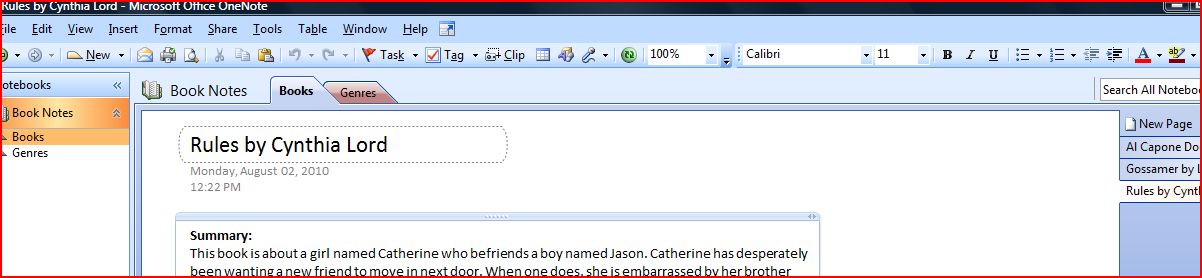 The image shows my personal experiment with OneNote. I have create a notebook with my novel study books. I knew that I wanted a place to write down summaries and questions that I could use in discussion groups or as reading response. I had previously thought about creating a Word document to store all of this information. The major problem with that is ensuring it isn't cumbersome. I want to be sure that I can go back and refer to my notes, even if I don't utilize the questions I have written down. My hope is that it will save a little bit of my planning time. You'll never guess the trouble of ensuring you've read all 4-5 books in your novel study, while also being sure you've got all of your other reading (instructional materials, social studies, current events) taken care of!
In the future I think I will include tabs for different book groups, grouped by genre or category. I've started a Genre tab, but it falls short in some of the sorting capabilities that Excel has. I have a different document in Excel that has all of my multiple copy books (or most... well, many). I can sort it by title, author, number of copies, or approximate reading level. It isn't perfect, but it definitely helps out with some of my planning.
Monday, August 2, 2010
Back on the Horse
This afternoon I walked into a local Starbucks in search of a little pick-me-up. I encountered a former co-worker (I was a barista while I was in my t-cert program), and we exchanged hellos, how are yous, and whatnots. He asked what I was doing today, to which I replied, "I spent the morning in my classroom, about 3 1/2 hours or so." He replied, with his face one of puzzlement, "What, are you teaching summer school or something?"
While I have certainly enjoyed a relaxing summer, I've started the process of getting back on the horse. I had a few simple tasks today:
While I have certainly enjoyed a relaxing summer, I've started the process of getting back on the horse. I had a few simple tasks today:
- Take old, tattered, expired books off the shelves to make way for newer books.
- Check to see if school laptop worked better at school than home (startup issues)
- Move some charts and maps from the wall in my search for a better way to utilize wall space
- Look for assessment guide, in particular leveled passages to assess fluency & comprehension.
What I ended up doing, taking up more time than the above items, was documenting some of the books I've been reading this summer. This past year my school district used some of our technology stipend on learning Microsoft's OneNote. In a nutshell, OneNote is a digital binder. We use it for documenting our staff development, and team meetings. I've also used it to document my work with students in reading, using different tabs for each rotation of kids that I would see and placing pages in each tab with the date for my reading conferences. Kids would read while I was script on my laptop, typing notes about fluency or comprehension including areas of growth/struggle.
I decided to employ this for the books I've been reading. Ever read a book, dog ear a page, then wonder what the heck you did that for (when you look back days, weeks, months later?)? Well I haven't totally determined my organizational structure yet, but I have a few pages on different books. I included a brief 2-3 paragraph summary. After that I included page numbers with quotes and questions, things that I might use when I use these books again. While I might not use the questions that I've noted, at least I have a head start the next time I go back to use these books.
I was in my classroom today? Yes I was, and it was good to be back on the horse.
Good Reads

(image from sfkids.org) Today I am making the trek in to school. My wife is at an orientation for National Boards, so I am left with little to do but run and work. If I don't head to school, the likelihood that I use my creative energy is slim to none.
After reading the Red Pyramid (certainly recommended), I decided to read Al Capone Does My Shirts. I really enjoyed it, which is saying something for someone that doesn't typically like period literature. I prefer more modern stories, largely because of the ability to relate to the characters and story. But this was fantastic, and featured an ending that I was not expecting. The characters were believable and easy to identify with. Their problems seemed realistic, but didn't cripple the story. I'd like to use it for a novel study (character traits-growing up in particular, inferences/predictions) but I am a little bit nervous about that.
Why am I nervous? It is just a story, right? Part of the problem lays in how realistic the literature is, as Choldenko did a wonderful job authoring this story. Near the end there is a scene where the main character (Moose) and his father are talking about the struggle their family has had because of the strain Moose's sister has created. She is a young adult with special needs (autistic), and the family has struggled in balancing those needs and normalcy. In this late scene Moose's dad is tired, and he pours himself a beer before pouring a little bit into a glass for Moose. Moose acknowledges how odd this is, but also how important their conversation must be (partially because of his dad's action). He doesn't drink it, but the few lines about this make me a bit nervous. On one hand, you can feel the realism seeping out of the page, sensing the depth of their conversation. But on the other there is no possible way to condone or explain the action of Moose's father. We can talk, as educators (or society- what have you), about taking the kid gloves off and not censoring things that kids see around them. That is easy to say until you feel like you might be the first experience they have without that aforementioned censorship.
Sunday, July 25, 2010
Summer Reading
My wife and I are heading on a little mini-vacation this week. We'll be back by midweek, but will spend the first part on the Washington coast. I'm bringing a plethora of books with me, mainly those that I hope to use for my novel study groups this year (one or two that aren't)...
- The Red Pyramid- Rick Riordian (new series with Eygptology by the author of the Lightning Thief/Percy Jackson books)
- Sounder by William Armstrong
- Al Capone Does My Shirts by Choldenko
- Wringer by Jerry Spinelli
- The Breadwinner by Deborah Ellis
- Mrs. Frisby and the Rats of NIMH
- Gossamer by Lois Lowry
I'd rather have too much to read than too little. Plan is to pull up a chair and read by the ocean for copious amounts of time.
Subscribe to:
Posts (Atom)