My kids are pretty good at making predictions. I think it is a skill that many kids become fairly adept at, largely because they do so on a daily basis. The real trouble comes in supporting our predictions with evidence. We've gone over this process before. It goes something like this...
Me: Ok, so we've established the problem to be that he is taking a shot from half court to win a million dollars. What do you think will happen?
Student: Well he makes it obviously.
Me: Fantastic! He makes the shot, he wins the million dollars. What makes you think that? It is a long distance shot.
Student: Well, all kids stories end happily.
Right! I forgot! Most kids stories to that point tend to end relatively happily. Then it becomes a matter of teasing out the other details... he wasn't good until he got a coach. He really wants to make it, and he is listening to his coach... often coaches make you better, hence you'll be more likely to make it than before!
If you've read the blog before, I am a fan of Dan Meyer'sWCYDWT (what can you do with this). The idea is to take banal problems, and bring them to life using the "technology that is ubiquitous." Often problems lack relevance or provide too much information, eliminating the need for creative problem solving. He uses this for math, but I'm going to use it to illustrate predictions in reading and how to write those out with evidence.
We are going to watch the final 10.8 seconds of the 2008 National Championship Game with the title of the video out of sight (Kansas vs. Memphis.. linked above). We'll start with what information we already have: 2 point game, guy from the leading team at the foul line about to shoot 2 shots. What are the possible outcomes of this situation? He could make both, miss both, or make 1 of 2. Now what information might you need to make a prediction? We'll look at how he has done on the season, and how he has done in this game. From there we'll make some guesses.
After that we'll watch until 4 seconds to go. The 3 point shot is about to go off. We'll repeat the process. What could happen? What information do you need? We're dealing with real life, not simply a kids book. In this case the statistics (if looked at longitudinally) actually lead towards the actual result, the making of the 3 point shot. He had been awful to that point, yet making the 3 pointer would bring he really close to his average, something they have worked on before. It doesn't matter what the prediction is, as long as they reference the evidence leading in that direction... we're going beyond "Well, I just think so."
Where does it go from there? We then apply that to modified passages on 3 settlements- Roanoke, Jamestown, and Plymouth. They don't include the last 2-3 paragraphs that tell how it ended for the settlement (and few have the background knowledge to know the outcome). They'll make predictions, support it with evidence, and rank each from most to least likely to be successful. We'll post them on our online discussion board, and have a virtual (as well as in-class) debate about success. I'm excited for it.
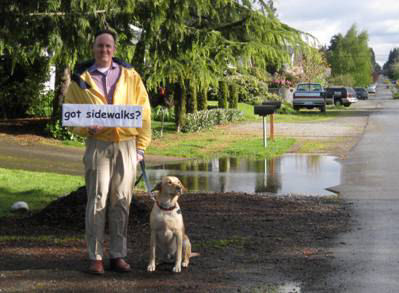
Got sidewalks? Parts of my neighborhood don't (as seen to the left... although that is from flickr and isn't me!). An image like that one to the left is going to be the opener for my CBA. As part of the guided release process we will do some visual discovery using 1-2 images from my neighborhood. From there we'll talk about questions we wonder about, and if there is an issue depicted. The natural progression should be: I see a place without sidewalks, the issue is whether all neighborhoods should have sidewalks. People need to be safe when walking around their neighborhood.
I really like the state CBA. It asks kids to ponder current issues by thinking about stakeholders, and how rights or the common good are impacted. The key is effective modelling. Kids need to see how to brainstorm different issues, research different points of view, and put it together in order to persuade others to see your position. We've worked at length regarding seeing multiple points of view, but it can be difficult applying it to a new setting that is more open-ended. I'll likely give lots of freedom, but enough structure that kids see where we are going. Graphic organizer? Yep, you need to use it. Presentation format? Yep, needs to be PowerPoint, brochure, or essay. Can you do any issue? Sure (although guns, death penalty, and drugs are out- those not school appropriate). Will some kids need more monitoring and guidance? Yep. You just need to know who those kids are.
The Constitution and the Bill of Rights are next on my list. Instead of some of the in-depth work that I wanted to do, I am doing more simplistic reading comprehension work. As I mapped out the final few weeks I saw how little time I really allotted for the CBA. I expected that the question formulation, research, drafting, revising, and completion would take 2 weeks. It should... but not when the 2 weeks have other odds and ends mixed in (like Memorial Day, Field Day, Talent Show, etc). Ugh!
The solution is to condense a few things in order to ensure enough time to finish the CBA in an appropriate amount of time. The goal is to go over branches of government and talk about rights, with a progression into particular issues that kids brainstorm. We'll start the brainstorming together, using a WCYDWT sort of thing. There are a few different approaches I am tossing around. One might be 2-3 images (something like the arrival of construction equipment, a map, and blueprint) and 1-2 questions for kids to wrestle with- how might this impact the community? what are the positives/negatives of this event?. Another idea is to have one image (something like open green space, or a wetland) and start entirely from scratch- what does this image make you think of? how is this image important to the community? I am not 100% how I want to approach it, but I do know that the latter was done (by me) and was successful in some ways.
The ultimate goal is to get kids wondering about issues around them. I want kids to ask questions that naturally lead them into research, and naturally lead them into supporting/refuting their opinion. I do know that I am going to restrict the presentation formats. Just because you have access to 8 or 9 different platforms doesn't mean you need to use all of them. I've got 7-10 instruction days left before it starts. Should be fun!
One of the things I struggle with is making American History applicable in 2011. Some students just can't identify with history. It ends up being boring, and lacking in some of the advantages of artifacts and things in present-day. To me, that is what draws me to things like WCYDWT and Dan Meyer's other math problem solving ideas. Using multimedia that is visually interesting, and inspires questions that you want to solve gets kids really involved in learning.
On a daily basis I teach reading through social studies (and with some novel study). Specifically, I teach American History pre-1800. My teaching includes the Stamp Act. It includes the redcoats. It includes US government in basic structure. In what ways can I integrate present-day multimedia beyond simply drawing analogies? That is the challenge I am going to wrestle with heading into the close of the year. I've got some ideas for the CBA (classroom based assessment) that I'll share tomorrow (hopefully).
I would start with the image on the left (courtesy of KWTV in OKC) with no other information. The next task would be to ask the kids:
-What questions do you have about the image? -Describe what you see in the picture?
There are a few things that the kids will be practicing as they do this. For 1, they will be practicing asking questions which is integral to everything (in particular in reading). For 2, they will be making inferences from what they see. They are saying "water is high, dark skies, then I can reasonably infer that it is raining hard and maybe causing a flood." People are having a difficult time because there are cars that aren't moving, and one has its trunk open, which is not normal.
From there we go to: what questions go together, and how can we make an organized attempt at learning more information. Perhaps even going as far as "what do we hope to know when this is all done?"
I feel like this can be done using everyday images that are both local and international. It intersects well with our current events, which will start far earlier in the year.
I'm in the midst of evaluating our CBAs. I'm reading their work (most of which are powerpoints), checking their self-evaluations (OSPI rubrics), and providing feedback. The process is somewhat tedious, and certainly frustrating. Why? There isn't a way for us to go back and make changes to improve them is one reason. The second is that many of the errors are a result of revision, or lack thereof. Items on the graphic organizer that didn't make it into the presentation.
Ultimately I have some changes to make to the process. First, we'll start it in April instead of late May. We'll have an outline of the days, and what work will be done each day (at least at the start).
Monday 4/5- Research using search terms- find one article on elibrary/print
Tuesday 4/6- Research using search terms- find one useful website/print
Wednesday 4/7-Deciphering research- what to use.
While we had our specific days, with explicit purposes for each, some of the points were lost in translation. Ultimately the goal is to ensure that they are successful, which providing some of those scaffolds will do.
We'll also do another WCYDWT sort of thing. That, to me, was how I started off the CBA. We started with an image and talked about it, wondered about it, gathered more information, then started on a trajectory towards putting something together. We struggled with the process of utilizing our research to the fullest extent possible. Using pictures, particularly current events stuff, is right up the "what can you do with this" alley. Kids want to know more, and want to try and make sense of the world around them. They just need the tools to do it, which requires reading, writing, and research. If I had a rewind button I'd be hitting it, putting it on 5x fast.