Showing posts with label summer reading. Show all posts

Sunday, August 28, 2011

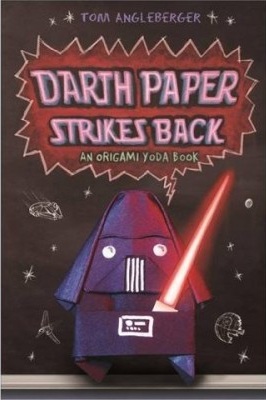
Darth Paper Strikes Back

I made my rounds of local bookstores on Friday. I typically like to have a good feel for books that are out and available, which means visiting every few weeks. When I visited the UBookstore by the University of Washington, I came across the sequel to The Strange Case of Origami Yoda. I loved Origami Yoda, but wasn't all that crazy about Angleberger's second book Horton Halfpott.

The back story is as follows... a geeky 6th grader named Dwight has made an Origami Yoda that he puts on his finger. He offered advice to kids who thought he was crazy, but often followed the advice (sort of like "I'm not really sure what to do, so I might as well follow yoda"). Yoda often turned them in the right direction... or was it Dwight?

The entire first story is mini-stories, vignettes, from kids that used origami yoda successfully. Along the way, a kid named Harvey is the villain to Dwight's hero. He cast the shadow of doubt about yoda being true, instead offering up the suggestions that Dwight is just talking crazy, or that the advice is ambiguous (for Star Wars fans, isn't Yoda always ambiguous!?!). In the end we don't find out whether Dwight is yoda or not, leading us into Darth Paper Strikes Back.

Harvey loves Star Wars too, making his own origami... Darth Paper. In the first story everything goes right... in this one, without the guidance of origami yoda (since he might to be kicked out of school for details I won't reveal), Darth Paper brings about the ways of the dark side. What can go wrong does go wrong. The story is about trying to make sure Dwight doesn't get kicked out of school. It is well done, just as the first one was, and a tremendously fast read. Well done.

Rating: 4.5 out of 5. Only gripe is that it is dangerously close to the first story, following the same story pattern. I'd like to see a bit more variation, but still really enjoyed it.

Saturday, August 27, 2011

The Curse of the Bane

It has been a few weeks since I have put up a book review. That is largely because I've lacked some of the desire to push through books. Whether it is the sun, the Internet, or something else, I've dwadled through this last book.

I really enjoyed the first book in the Last Apprentice series. I likened the book to the Percy Jackson and the Olympians series, but more realistic and with a mixture of old world witchcraft lore. The second book, the Curse of the Bane, started very slowly. We are reintroduced to the Spook and his 13 year old apprentice Tom Ward. Tom is the 7th son of a 7th son, which makes him special in old world lore.

The crux of this story surrounds the Bane. It is an old creature that used to wreck havoc on the countryside, but was bound to the catacombs under the city of Priestown. Now the Spook is going back to try and finish off the Bane once and for all. Along the way there are a myriad of complications, the biggest being the Quisitor. Why is he the biggest obstacle? He is judge, jury and executioner for witches or those that deal with the dark. Unlike the Spook, he has little or no idea of how to identify those aforementioned people, essentially making him a thief and crooked government official. The story makes me want to read the third in the series (it has at least 8 books), but I've got a few others to read first.

Rating: 3 of 5. Was better than average (I don't want to give a score of 2.5, that is like being noncommital) but not great. Next up is either Darth Paper Strikes Back or NERDS.


Sunday, August 7, 2011

Bird in a Box

Bird in a Box was another of the books I'd purchased for my Mock Newbery Project. The story was one that I ended up enjoying, but that took me some time to fall into. It is three separate but connected stories. Set in the 1930's, these three African American kids have seen more than most kids should have seen. Their stories are set against the backdrop of the famous boxer Joe Louis having his fights broadcast to radios across the country.
The three stories are engaging in their own right. Each chapter is a point in time, with a section for each child. Where I caught myself looking back into the book was in differentiating Willie from Otis. One has fled his abusive father, while the other had his parents pass away in a car accident. They become tied together through the orphanage they are living in. Following me? I know a few of my kids will be lost in the stories of each kid, later getting confused as they try to connect events to each character.

Overall I really enjoyed the story. You could feel the pain of each character, but also the hope that they held close to their hearts. I wonder if the story would have felt more cohesive if it expanded more on one character rather than having all three. All three were well done, but they seemed like vignettes at times. I certainly see this as a Newbery contender. One of my favorites of the summer.

Rating: 4.5 out of 5

Thursday, August 4, 2011

The Trouble With May Amelia

Have you ever been reading a book that you were told was really good, but you were only passively interested in? That about sums up my experience with The Trouble With May Amelia by Jennifer Holm. The story is a sequel to Our Only May Amelia which was a Newbery Honor Award recipient in 2000. I found my experience with this story to be similar to my experience with The Penderwicks. I'll digress to that in a second.

The Trouble With May Amelia is one of the Mock Newbery recommended books for 2012. From those that I have seen on goodreads, and via various library blogs, this was to be a fantastic book. The storyline surrounds a girl named May Amelia Jackson who is growing up in Washington state at the turn of the 20th century. Her family is Finnish, and have settled in an unincorporated area on the Nasel River. This area is accessible only by boat, and the living is tough.

May Amelia's family struggles to get by with the work on the farm, and with many children (all 7 are boys except for May!). May Amelia fights for her place in her family, particularly as her father has proclaimed girls to be useless. The real trouble begins when a man comes to town looking for stakeholders in a company that plans to incorporate a town in this otherwise inaccessible area. The plans are to make this the Seattle to the south. It is then that the story really picks up, and you watch the growth of May Amelia and her family.

What I discovered through reading this story is rather simple: I struggle identifying with protagonists that are female. This was the same experience I had with the Penderwicks. I found myself wanting the main characters to stop needing to prove themselves as able or ready. The Penderwick girls were confident, but the story didn't give them enough assertiveness. I wanted them to act a bit more, which perhaps is another similarity in the stories (and might be another issue I have these types of stories). May Amelia proved herself to be more than able, but I wanted her to be more assertive. I stuck with it to see what would happen to May Amelia, and to see if she'd change.

Rating: 3 out of 5. Well written, aside from lack of quotation marks (my kiddos may be annoyed by this). Storyline was good but dragged. Last 60+ pages (last third) were well done.

Tuesday, July 26, 2011

Small Persons With Wings

Summer book reviews continue! Fancy that. Small Persons With Wings (by Ellen Booraem) is another potential Newbery Award book this year, at least if you follow some of those trying to predict the winner. Do I agree? Not so much.

Small Persons With Wings is a story of growing up and make believe. Mellie has grown up with a "small person with wings," a fairy by any other description (but they don't like to be called that). She has enjoyed having Fidius around so much that she told all of her classmates about him. When she tried to bring him in for show and tell he left, leaving her with nothing to show (and resulting in being made fun of by her peers). Worse is that she seemingly hijacked a birthday party of one of the cool kids, leaving her to feel that girls wrath throughout her childhood.

Mellie is referred to counselling because of this make believe issue. When her parents come in for an intervention, they confess that fairies don't exist. The result is Mellie stifling her beliefs, and pouring herself into art and science books to keep out the make believe thoughts. The family eventually needs to move to Boston because they've been told that Mellie's grandfather has passed away. Upon arrival they meet a horde of fairies, the Parvi Pennati, which prompts her parents to admit that they are aware of the existence of these small fairies... er, small persons with wings. The rest of the story takes the reader on a journey learning about the Parvi, why they are there, and a plan to help the Parvi return what they've lost over the years.

Does this book have a home in my classroom? Absolutely. I enjoyed it, particularly because of the lessons about bullying and self image embedded in the storyline. I think it has a niche with those students that like a little twist on reality, added fantasy to your typical storyline without too much of a departure. Where it falls short of some other books is that the story seemed to drag too much in the middle. The beginning pushed you along and you felt for Mellie. Once you arrived in the middle too much time was spent on the Parvi, magic, and the people next door. It had enough twists to keep you interested, but not enough meat in the story to really make you want to finish (*I used to be a big closer of books that I lost interest in, but have since opted to try and finish most of my summer reading in order to be fluent in kid lit.) I don't see the Newbery in its future, but we'll see.

Rating: 3 out of 5.

Wednesday, July 20, 2011

Reaching Balance

I've slowly started the process of reading professionally. I opted to take Guiding Readers and Writers with my while camping. After doing some kid lit reading, I decided I needed to start the ball rolling on improving my practice. I've also done some reading on the Units of Study Reader's Workshop from the series I purchased earlier in the year. There are a few things that I want to address over the course of the summer:

-Balancing reading/writing instruction
-Balancing reader's workshop with social studies materials/instruction
-Being strategic in using technology to meet our reading/writing goals
-Better and more strategic/planned use of formative/summative assessment

Guiding Readers and Writers is a bit daunting. It isn't a book you'll read straight through. Instead it is better to read in chapters, particularly being strategic in those chapters that will meet what it is your looking for. Sounds simple, but being a linear person it really isn't (after Chapter 1 I should read Chapter 2, not 7!). From the limited amount that I have read, there are a few things I've determined. I'll address one of them today.

My big takeaway thus far is that reader's workshop and my social studies instruction do not mesh very well. Reader's Workshop features an emphasis on Independent Reading. After a book talk and/or mini-lesson of 10 or so minutes, students read independently. They work on charting their progress afterwards as part of a debrief. The lessons are meant to support students as they choose their own books. There are elements of this that I intend to use, but I can't use it wholesale. Why? The way we have our literacy work setup currently is largely through social studies/non-fiction. Obviously there are two glaring holes: 1) where is the fiction/independently chosen books, and 2) where is the independently chosen non-fiction.

Can I integrate the Guiding Readers/Units of Study information? Yes. I just need to be a little choosy. I'll likely do a mini-lesson on Monday. I'm undecided if that means I'll do an entire day of Reading Workshop, monitoring kids reading through some conferring. That might also mean I do 15-30 minutes of reading followed by some social studies work. I'm leaning towards the former, as the latter ends up being scattered. The remainder of the week will likely involve my usual 15/45 minute split of independent reading with social studies instruction. I've got a lot to learn... at least I've got my books organized in one area currently (as seen below).


From Drop Box

Tuesday, July 19, 2011

Okay For Now by Gary Schmidt

Okay for Now... one word: fabulous! While it is at the upper end of reading for kiddos in my grade level, it is a great addition to my library. Why is that? The story was incredibly realistic. As a reader, you could empathize with the struggles of the main character (Doug Swieteck). The problems were incredibly realistic, yet the storyline was not nearly as predictable as others I've read.

The long and short of it: Doug is a character first seen on the fringes of the story The Wednesday Wars. His father has lost his job so the family is moving out of Long Island (NY) to a mill town further north. There are a myriad of issues for Doug to overcome. His father is negative, almost to the point of being abusive (certainly a bully). His older brother of two years is a bully who runs with a bad crowd. His oldest brother is in Vietnam and set to come home soon, but not the same. All of this is added onto the fact that Doug can't read yet is heading into 8th grade.

This story shows many things. You see the growth of characters. You see characters change (for the better). You also watch the goings-on in a small town where everyone knows everyone, and your reputation precedes you. Best book of the summer by far.

Rating: 5 out of 5... definitely on the short list of the Newbery Award in 2012.

Friday, July 15, 2011

Juniper Berry by Kozlowksy

Recently I ordered a handful of books that bloggers have noted as possible Newbery candidates for 2012. Typically I don't order hardcover books. I find the price to be a bit much, and the size/heft of paperback books to be preferable. But since many of the Newbery books are new releases I found myself in the position of *needing* to order them in hardcover. Alas I digress (as an aside, my goodreads list is here).

That brings me to Juniper Berry by M.P. Kozlowsky. I'd seen it prior to doing my Mock Newbery research, faced out in a Barnes and Noble and later in Third Place Books. The basic premise is that sometimes wishing for things can lead us down a path to being someone we don't want to be- whether consciously or not. It is a classic tale of temptation and using will willpower to avoid "darkness."

Juniper Berry's family should be a fairy tale. Her parents are movie stars. She lives in a large house with seemingly endless methods of amusing herself. But something is awry. Juniper's parents grow increasingly dark and angry. Her fairy tale is disintegrating. One day, in the rain (oh the symbolism!), she meets a boy named Giles. His life has a familiar ring to Juniper's, and they find that their parents are connected by this twisted old tree in the woods. What follows is Juniper and Giles trying to resist the temptation of having the dreams made a reality. They'll also try to reclaim the life that they had once before. I enjoyed it... it wasn't my favorite. Juniper lacks depth as a character, and the storyline is familiar. But it was well written, and there are enough twists in the story to keep you reading.

Rating: 3 out of 5.

Thursday, July 14, 2011

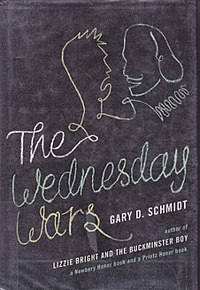
The Wednesday Wars

I was very impressed with Gary Schmidt's The Wednesday Wars. In fact, I'd say it was fantastic. I wouldn't expect much less since it was a Newbery Honor book in 2008 (as a sidenote, I'd never heard of the winning book Good Masters! Sweet Ladies! Voices from a Medieval Village until today). This story was vastly different than what I expected, which is to say that I really didn't read the book jacket very carefully!

The story is centered around a sixth grade boy named Holling Hoodhood (nope, it isn't a misspelling:). We watch him over the course of his school year, particularly focused on Wednesdays. Why Wednesday? That is the day when half of his class goes to Catholic school at 1:45, and the other half rolls out to synagogue shortly thereafter. His teacher, which Holling thinks is out to kill him, starts off by having him do menial tasks around the classroom: clean erasers, clean out the put cages (rats mind you!), etc. Later she has him read Shakespeare, which he really dislikes because of the old world writing that is difficult for an adult, let alone a 6th grader, to understand.

What makes the story captivating is the backdrop. This is during the late 60's when the Vietnam war is happening. This touches many in the story, from the teacher (Mrs. Baker) to others in the school community. Walter Cronkite is being watched at night, and there is a bit of tension that the reader can feel as the story winds onward. Lastly, you have the family with a strong willed father (determined to be the businessman of the year), the mom who is going along with the will of Holling's father, and Holling's sister who listens to the Beatles and runs away to find herself. All the while you follow Holling as he struggles to find himself and grow up in middle school. The growing up plays back into Mrs. Baker's assignments to Holling of reading Shakespeare. Overall, well done.

Rating: 5 out of 5. Growing up is a theme in many stories, but it is done masterfully in this story. It made me really excited to read Okay for Now, a follow-up of sorts to the Wednesday Wars (but with one of the side characters as the main character... it is high on the Mock Newbery lists I've read thus far).

School of Fear

I picked up School of Fear around the holiday break (way back when it was 2010!). At the same time I had 1-2 kids who were already reading the book since they'd purchased it, or received it as a gift. The early reviews from kids were that it was awesome. As a few other kids read it I noticed a struggle to finish it, particularly as kids hit the midway point. That isn't a good sign, but it still remained on my to-be-read list.

There is a fairly basic premise to the story. Four kids have very different phobias. The fears range from avoidance of water to believing bugs are everywhere (so you bring repellent with you to spray everything!). All of the kids are brought together, through their own doing or that or their parents, at the School of Fear. It is an odd place with an odd teacher. The teacher's motto: a beauty contestant is always prepared. She has an odd way of helping them overcome their fears... until she dies unexpectedly. That is where I'll leave the summary, so as not to reveal the ending.

I was less than impressed with the story. I found the 4 kids to be funny at the start of the story, but their humor wore off somewhere around the middle (which jived with what I was seeing in my classroom). It picked up again in the last 1/3 or 1/4 of the story, but it wasn't enough to save the lull in the middle that was filled with dialogue/arguing amongst the kids. There is a second story out in hardcover. I opted to wait until it is out in paperback, saving my money for something a little more substantial.

Rating: 3 out of 5. Better than average because of the humorous phobias. But missing some of the substance in the storyline that I'd seen already this summer.

Saturday, July 2, 2011

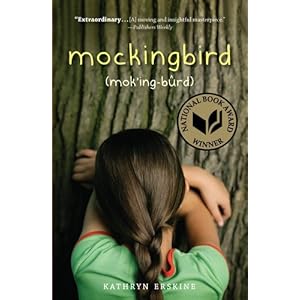
Mockingbird by Erskine

I am a bit of a book fanatic. In my spare time I cruise over to bookstores. I often say I'm just browsing, but I will typically walk away with 5-10 books to bring back to my classroom. Part of that is because I have a running list of books I want to pick up. I've scoured Newbery lists, Young Readers Choice, Global Reading Challenge, etc looking for new books to get. Sometimes I have that list physically, but more often not.

Mockingbird has been on my list for about a year now. It was out in hardcover (fun fact: I really dislike hardcover books- size, weight, cost!) and I was to get it from the library. Yeah, that didn't happen. Instead I waited until it was in paper to get it. When that happened, I immediately purchased it. Time was short, so I did what I always do: pushed it towards some of my kids allowing them to be the litmus test. The early reviews from them were very positive... so it ended up on my summer reading list.

The story is about a girl with Asperger's. Her family has just been befallen by a second tragedy. First was the passing of her mother due to cancer, and the second is the passing of her brother after a school shooting. Her trouble has less to do with his death, and more to do with the emotion that everyone says she is supposed to have. Being on the autism spectrum, she struggles when things aren't black and white.

Over the course of this story you get a small glimpse into what might be happening for someone with this disability. Processing things that take nuance and finesse are incredibly difficult, and making friends is hard. Couple those with the tragedy those around you are dealing with (and you too, but in a different way) and you have a mountain to climb. While the subject matter is touchy, heart wrenching in fact, the power of seeing our main character (Caitlin) work to overcome these many struggles was incredible. I'm really excited to have other kids read it.

Rating: 5 out of 5. It didn't win the National Book Award for nothing I guess.

Friday, July 1, 2011

Horton Halfpott

I really enjoyed Tom Angleberger's first book, the Strange Case of Origami Yoda. As I was walking through the bookstore the other day I saw Horton Halfpott, his second release. Since I was so excited about his first book I had to give this one a read.

A few words... If you don't like old English, this book is not for you. If you are not really into irony and sarcasm, this book probably isn't for you. If you don't like books with more than 4-5 points of view, this book probably isn't for you. Then who is this for? Well good question.

The story is about a servant named Horton Halfpott who works at M'Lady Luggertuck's mansion. She treats the staff poorly until her corset is loosened (no joke!). At that point all goes awry. Luggertuck's nephew wants to come stay at the mansion to woo a neighbor girl. Sounds good, right? Unfortunately (or fortunately for the story) Luggertuck's son devises a plan to steal the "lump," the source of the Luggertuck fortune, and convince the girl to marry him instead of the nephew. Ah, but the servants and Horton need to save the day. Horton, the noblest and quietest of the servants, becomes our main protagonist. He is certainly a likable character, far more than the Luggertucks. That is where I'll leave it so as not to give away any of the storyline.

Rating: 3 out of 5. Not overly predictable, but certainly not of the same high standard that Origami Yoda set.

Thursday, June 30, 2011

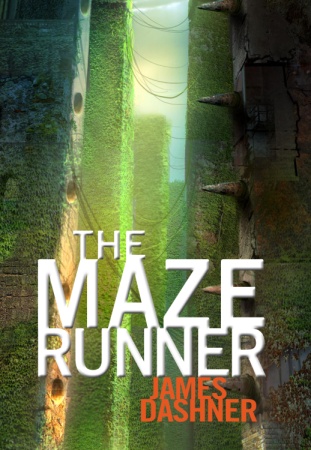
The Maze Runner by James Dashner

Earlier this year, I had one or two students reading the Maze Runner. I looked at the back cover and read the description, and was certainly intrigued. It was definitely going onto my list of books to read this summer. I just needed to go buy it!

Well I purchased it a week ago, and was excited to tear into it. Part of the reasoning was because it was part of the Young Readers Choice Awards, a Nominee for 2012 in the Intermediate category (more on that later). After finishing it, I really enjoyed it. I just need to figure out if I am going to bring it into my classroom (and when!).

Synopsis: There is a maze. No one knows where it is, why it is there, or how anyone has gotten there. There are boys in the maze. One comes out of this box (think elevator shaft that transports them there) every month. There are also things called grievers that come out at night and can shock or kill. Oh... and no one has any previous memory, as it appears to have been wiped clean.

Then a boy named Thomas arrives. All is the same, he has lots of questions, and life continues on. Thomas has hazy, fleeting feelings that he remembers something about this place. Everything changes the following day... a girl arrives, which is odd for two reasons: 1) no girl has ever arrived and 2) it breaks up the two year pattern of one person, once a month. From there you can say the book gets running. Thomas yearns to become a runner, someone that maps the maze looking for an exit. He gets his chance after saving two boys trapped in the maze. His skills are needed as their world appears to be rapidly speeding towards a conclusion. I'll save any more, for fear of giving away too much.

I liken the book to the Hunger Games. This past year I didn't bring out the Hunger Games until January because it was so advanced. I'll likely do the same with the Maze Runner. There are elements of the book that I question (example: they save shuck it, which is an obvious allusion to the curse). That being said, I felt like the same conversations I had with kids about the Hunger Games would apply here.

Rating: 4.5 out of 5 (lost the .5 because of the shuck it business mentioned above).

Monday, June 27, 2011

Shadow Children by Margaret Peterson Haddix

I just finished up Among the Hidden by Margaret Peterson Haddix. This is the first book in the Shadow Children series. Haddix's other series, the Missing, was a huge hit in my classroom this year so I wanted to give this series a go. I found it to be interesting, dark, and potentially a bit over some of my kids' heads with the content.

What's it about? Luke is the third child in his family. Normally that wouldn't be a problem, but the country is in totalitarian post-crisis state. In years prior, famine had spread throughout the country causing the rise a military dictator. He instituted population laws, stating that families could only have two children. The third child, if found, could be taken away and the family would be in significant trouble. Luke is a shadow child- he is destined to never see the outside world.

Luke struggles with this, angry for much of the book, until he realizes that there are other third children. One lives nearby, and he sneaks out to meet her. She introduces Luke to things he has never seen- computers, junk food, etc (all because the government has banned many of these things). She dreams of being free which inspires Luke. But this is a tricky, tricky matter putting Luke's (and Jen's) family in danger.

Long story short: I had this in the classroom this year after mid-year. The kids who liked Found and Sent enjoyed this book. Some put the book down, which I believe was connected to the content. The book deals with a dystopian landscape, not unlike that in the Hunger Games. Overpopulation and famine are issues. Issues of food quality and government restriction exist as well. While they are questions raised today, I wonder whether some of my kids will have the schema to really put the puzzle pieces together (and the stones throw from realism in the story).

Rating: Three out of five stars (I know, the rating is new... but I want to get in the habit of doing this since I will ask my kids to do this in the fall).

Next up: The Maze Runner by James Dashner

Sunday, June 26, 2011

Alvin Ho, Allergic to... Everything

I just finished reading Alvin Ho (book 1) by Lenore Look. It is listed as a Young Readers Award nominee for 2012, so I decided to give it a read. After doing so, I was left unimpressed. The story is about a 2nd grader, Alvin Ho, who is quirky. He doesn't talk at school out of some sort of fear, and he tends to be rather literal or cautious in his actions.

I have a few qualms with the story. The first is that it doesn't really have much direction. Alvin matures a little towards the end of the story, finally making a friend (something he lacked throughout the entire story). But it ends up being a myriad of vignettes chronicling Alvin's day in and day out. Beyond that, Alvin's oddities are many leaving him a tad overwhelming as a character. While many of his oddities fit for someone in elementary school, I've rarely seen all of them wrapped into one with kiddos.

Long and short of it: the book will make it into my library, and is much like Judy Moody except better. Some of my kids that struggle getting into books will enjoy this as it doesn't require intense amounts of focus to stay with the storyline.

Chasing Vermeer

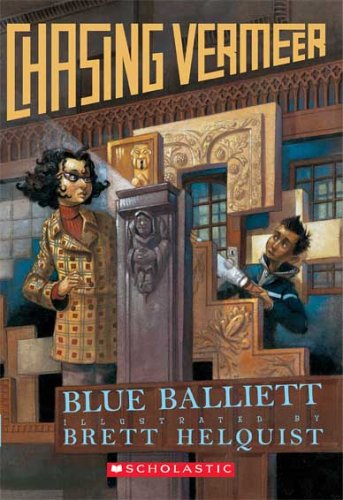
Just finished reading Chasing Vermeer. We have copies of this in our leveled library, and I have one in my classroom library, so I figured I'd give it a go. The story is about two kids, Petra and Calder. They live in Chicago and go to 6th grade at a school located at the University of Chicago. Their teacher is an art aficionado, and is big on flying by the seat of her pants.

At that point a famous painting called A Lady Writing goes missing with some mysterious ransom notes thrown in. The kids then try to find out where the painting is, and why their teacher (and two others that they know) seem to be mixed up in this crime. The chase to find the painting, and the quest for the "real" Vermeer works leads them into danger, and is captivating at times.

There were a few missteps, in my estimation. First is the problem solving ability of the kids. While 6th graders are bright, these two seemed to jump to conclusions awfully quickly, particularly an issue since they weren't friends to start with. Friends tend to finish each other's sentences, but these two were not really friends to start with. The second issue, for me, was the addition of pentominos. What are pentominoes? Essentially they are figures (letters) comprised on 5 squares. Together they can be put together to make rectangles. Calder uses them throughout and they tend to be ominous signs... except that Calder and Petra always guess what the letter means (since Calder fiddles with them and pulls them out of his pocket when nervous). I'd much rather be left to predict meaning than be told.

On the whole, I think the kids will find it enjoyable. I don't think it will be one of my top books, but it will be checked out for sure.

Friday, June 24, 2011

That's a Wrap

Yesterday was my last day in the classroom for the 2010-11 school year. We finished with kids on Wednesday, I got myself checked out, and then returned yesterday to clean out files before summer. It feels nice to be done, and to have a break from school (plus sleeping in until 7:30 or 8 instead of 5:45 is great!). This is my post-year reflection, and thoughts moving forward.

What went well?
The year as a whole was a success. I certainly felt more comfortable with the resources I was using, and with the pace that I was teaching at. As much as teaching is about data, it is also a social science where feeling and perception are important. On that end, it went well. Particular units/topics/pieces of instruction went over well. Studying the colonies and American Revolution were great, and our end of year CBA where students chose topics to investigate (deforestation, bike laws, video game violence) were all well received. My integration of technology into those areas likely helped those areas along, as we utilized netbooks for research and assessment (PowerPoint, PhotoStory, Publisher, etc).

I also felt like I did was far more effective with novel study. I used a wider variety of novel study books, all of which I'd read. I tailored my questioning to the books (as opposed to generic questioning), and focused on inferential/analysis questions. Kids were having really good discussions with their peers about books, which certainly made me very happy. I also felt like my classroom library lent itself to high quality reading. I bought a ton of books, and pushed them out to the kids. They responded by reading them (happily), and recommending them to their peers. This was a huge part of the 20 Book Challenge too. I'd say over 75% of the kids met the 20 book threshold, which I am happy with.

What could have been better?
At the start of the year I'd really wanted to integrate writing with social studies. In particular, I wanted to use the Units of Study throughout my social studies work. I abandoned that relatively quickly, largely because of the amount of time needed to make a piece of writing happen. Instead of having a few pieces of smaller writing to start with, I jumped into something a bit longer. That became a time vacuum, and I needed to move forward. It is something I want to continue but will investigate ways to better integrate it.

More discussion, particularly around analysis and inferential questioning. I did quite a bit with that this year. I'd still like to do more. I also want to better track my data using excel and pivot tables- more frequent, less invasive, natural harvest of data. I mean exit slip, short reading response types of things. I can do better.

What is ahead?
Lots of summer reading. Currently I am reading Chasing Vermeer, and have started the Golden Compass, and the Graveyard Book. I have about 20 books on my shelf. I also want to read Guiding Readers and Writers, but likely won't crack that open until mid July.

Wednesday, June 22, 2011

Bittersweet Symphony

School ended today. I will admit that I was running on fumes as we reached the finish line. Scoring the social studies CBA (classroom based assessments), reading assessments, and writing assessments left me drained. 65 assessments each, give or take a few, making for a huge strain on the brain. Add to that a field trip, whole school talent show, and end of year party and you've got a very tired teacher.

I was sad to see the kiddos go. Some of our kids from last year visited us again, and were sad to be leaving. Our kids this year were a good group also, and were sad to go (but excited for summer!). We were sad to see them go. But onward to summer. I have a few things to accomplish, and below is a tentative list....


  • Clean my computer files- tomorrow!

  • Clean all my paper files- tomorrow!

  • Do some room re-arranging- tomorrow... or in August.

  • Reflect on the school year- tomorrow or Friday (wrap it up! Blog about it tomorrow)

  • Do some professional reading (Guiding Reading and Writers by Fountas and Pinnell is high on my list, as is going through the Writer's Workshop books, and Reader's Workshop books)... mid/late July!

  • Read 2+ kids books a week... reviews to come. Only way to stay current!

Tomorrow I'll put a wrap on the year by going through some of the kids' reflections. From there it is time to relax and not think about school for a bit!

Sunday, December 19, 2010

Trackers by Patrick Carman


I have a few things to do over this Winter Break. The most pressing on the list is getting more sleep. Weeks of 5-7 hours of sleep (I'm up early on Sat/Sun for runs) grinds away at you, so sleep is number one.

I'm also planning some curriculum mapping. I want to look at the next few months and check over what units/content pieces I am going to be using, and which standards I'll hit. But the last big thing is reading. I've sworn off adult books, and only read blogs, professional development books, or kids books.

Last night I purchased a ton of books (list on previous post). I plowed through Trackers by Patrick Carman, reading off and on for 5 hours. If you read it in one sitting (and aren't easily distractable) it should take about 2-3 hours. Really light, but very engaging.

Trackers is about a 14 year old named Adam Henderson who gets into computers at an early age. His dad owns a repair shop, and Adam is allowed to run free on the hardware/software, getting to a point where he becomes a hacker or digital entrepreneur. Ultimately he makes gadgets and software that are very advanced, and is most intrigued by surveillance. He meets one of the other trackers, Finn, by chance in downtown Seattle. After that he meets the other 2 (Emily and Lewis). Long story short, they do a field test of some hardware/software and find out they are being watched. The person who watched them wanted Adam to find out, leading them through this puzzle or maze of clues that put you on the edge of your seat. How do they know Adam? How have they been watching? What do they want?

What is probably most fascinating about this book is its use of technology. It is definitely centered around computers and gadgets, sucking you in (at least if you like computers etc... which I do). But it also has spots at the end of sections where you can go to the appendix to read a transcript of a video... or you can go to the Trackers Interface online to watch the video that the appendix transcribed. The videos were well done too, which adds to the allure of the book. I watched 2 of the videos, and skipped the rest as I wanted to keep reading.

This book was the first in a series, which I am sure will become well read in my classroom. It seemed to be really similar to the 39 Clues (or at least what I've heard about the 39 Clues!). Next up: The Jaguar Stones

Friday, October 22, 2010

Reading Trends

We are in the midst of conferences. Kids are out early, and we are there into the early evening (often). The Scholastic Book Fair is also here, which is great. Personally I don't purchase much there, if for no other reason than I prefer used books. While Book Fair gives our school a small percentage of the sales, I find that I spend more than my fair share over the course of the year. I tend to purchase books every other week or so, usually stopping by Ravenna's Third Place books to check their used selection (and taking advantage of my teacher discount).

What are kids reading? Let's find out (in light of said book fair)...
  • The Lost Hero by Rick Riordan (I'm reading it too... 100 pages in, love it)
  • The Percy Jackson series by Rick Riordan (I have 2 copies of each title in the series, all are checked out... the Lightning Thief is on my 20 Book Challenge)
  • The Hunger Games by Suzanne Collins- I have my reservations about it, and intend to read it. I worry about the lack of schema, even if you can decode it!
  • Simon Bloom the Gravity Keeper by Reisman- purchased via Amazon, on my list of "need to read soon"... this is a Battle of the Books title.
  • Series of Unfortunate Events- oddly enough, the Lemony Snicket books that were wildly popular in the early half of the 2000's are all over the place in our 5th grade. Weird!
  • Guardians of Ga'hoole- The Guardians series took off partially because of the movie that is out (or is coming out, and I don't follow movies much). There is another series by Kathryn Lasky that I put on my Book Fair wish list, and I am excited to check those out too (The Wolves of Beyond).

It is excited to see the multitude of books being read, and the reading culture that is building in our cohort. Very very excited!