We are finishing our second round of novel study. I'm pleasantly surprised at the progress we've made. We can describe characters and identify story elements. We can make predictions, and provide evidence.
What we still need work on is writing at greater length. Moreover, I need to do a better job modeling what that looks like. I need to give kids a better model of how to link ideas together, knowing that too much is actually better than being brief. My kids, probably like your kids, like to be done so they can move on. Sometimes you need to linger.
Showing posts with label reading. Show all posts
Showing posts with label reading. Show all posts
Tuesday, December 11, 2012


Sunday, August 19, 2012
Integrating Content
I'm entering year 4 of teaching. This will be the fourth year that I work on a team of 3 that divides the work in the same vain as a middle school might. I am left with literacy, and social studies. Ultimately it is a significant amount of content as you are working through social studies information and skills while simultaneously working in reading and writing skills.
My subject areas are a natural combination. You can't necessarily access the social studies content if you can't use effective reading skills. You also can't effectively communicate your understanding, particularly the analysis behind events, if you aren't able to write. There is obviously one glaring and gaping hole. Anyone see it?
If you guessed reading and writing outside of the non-fiction/expository genre then you guessed correctly. How do you go about using your daily 60-80 minutes to ensure you go beyond nonfiction and expository writing? That is the same question I have been wrestling with my first three years of teaching, and I still haven't really found a satisfactory response. While a majority of my counterparts struggle with teaching enough nonfiction, I am tilted entirely in the opposite direction.
In curriculum mapping this fall I started with my Social Studies content. I know it relatively well, and can easily generate a list of essential understandings, guiding questions, and standards to match. This also helped me in thinking about it from a problem based perspective where kids are going to need to generate some sort of product where they will evaluate and/or analyze information. I don't necessarily touch the reading standards at that point, largely because I need to better flesh out those units. If I do more comparison work, I will integrate that reading GLE. I might do categorizing, or questioning, or something else (which obviously will change the GLE used).
But where to start with reading? I have the Units of Study and enjoy them, even though I find them slightly cumbersome. Instead of diving through them, I started with articulating what I want for my kids as readers. I also wanted to state why those things are important. For example, stating "I want them to love reading" is great but doesn't tell you why you should love reading. To that same point, I hated reading for the sake of reading as an upper elementary or middle school student. So why do I need to love reading? Having a clear vision that it is important due to all of the reading you do throughout your life just to simply function is important, let alone to actually process information so that you can make rational decisions (or enjoy yourself, have a conversation about a book, function at work, etc etc). From that starting point I started in on what skills I wanted to ensure I cycled through- inference, story elements, etc. While it isn't complete, I'm pleased with the direction it is going. As I consider who I balance out my days (and time blocks) I can see what time I might need to allocate to each, and how that use of time will work.
8 days until I'm officially back, and 17 until kids start.
My subject areas are a natural combination. You can't necessarily access the social studies content if you can't use effective reading skills. You also can't effectively communicate your understanding, particularly the analysis behind events, if you aren't able to write. There is obviously one glaring and gaping hole. Anyone see it?
If you guessed reading and writing outside of the non-fiction/expository genre then you guessed correctly. How do you go about using your daily 60-80 minutes to ensure you go beyond nonfiction and expository writing? That is the same question I have been wrestling with my first three years of teaching, and I still haven't really found a satisfactory response. While a majority of my counterparts struggle with teaching enough nonfiction, I am tilted entirely in the opposite direction.
In curriculum mapping this fall I started with my Social Studies content. I know it relatively well, and can easily generate a list of essential understandings, guiding questions, and standards to match. This also helped me in thinking about it from a problem based perspective where kids are going to need to generate some sort of product where they will evaluate and/or analyze information. I don't necessarily touch the reading standards at that point, largely because I need to better flesh out those units. If I do more comparison work, I will integrate that reading GLE. I might do categorizing, or questioning, or something else (which obviously will change the GLE used).
But where to start with reading? I have the Units of Study and enjoy them, even though I find them slightly cumbersome. Instead of diving through them, I started with articulating what I want for my kids as readers. I also wanted to state why those things are important. For example, stating "I want them to love reading" is great but doesn't tell you why you should love reading. To that same point, I hated reading for the sake of reading as an upper elementary or middle school student. So why do I need to love reading? Having a clear vision that it is important due to all of the reading you do throughout your life just to simply function is important, let alone to actually process information so that you can make rational decisions (or enjoy yourself, have a conversation about a book, function at work, etc etc). From that starting point I started in on what skills I wanted to ensure I cycled through- inference, story elements, etc. While it isn't complete, I'm pleased with the direction it is going. As I consider who I balance out my days (and time blocks) I can see what time I might need to allocate to each, and how that use of time will work.
8 days until I'm officially back, and 17 until kids start.
Tuesday, May 8, 2012
Writer's/Reader's/Social Scientist's notebook
Currently I use one notebook for writing, reading, and social studies. In many ways it is far from ideal. Why do I do it? Largely because of the structure of our rotations where my responsibility is literacy. One hour of literacy as fast as you can! Again, it isn't really enough but it is what we have (we also do an hour of mag and an hour of science). I will add that it has worked for us.
This year my journals have been divided into two parts. The front is for social studies content (and writing about social studies since it is embedded). The back is for reading of fiction, the stuff that really isn't US History- novel study etc. Next year I think I am going to do it differently. I will divide it into three parts: 1) social studies 2) word study and/or warmup work and 3) novel study. We'll use tabs or sticky notes to delineate sections to help keep track of what goes where.
The middle section is still a little fishy. I use Words Their Way to teach Greek and Latin roots. I typically provide 4 roots or prefixes a week, and they will look for words with the root, define them, and look for common patterns. I will continue that. But I also want a section for other vocabulary work, particularly things like misspelled words or adjectives (a big focus of ours). If I make it a section I want to use it... Can I get more out of that space? That is part of what I am thinking about as we start to wind toward the finish.
This year my journals have been divided into two parts. The front is for social studies content (and writing about social studies since it is embedded). The back is for reading of fiction, the stuff that really isn't US History- novel study etc. Next year I think I am going to do it differently. I will divide it into three parts: 1) social studies 2) word study and/or warmup work and 3) novel study. We'll use tabs or sticky notes to delineate sections to help keep track of what goes where.
The middle section is still a little fishy. I use Words Their Way to teach Greek and Latin roots. I typically provide 4 roots or prefixes a week, and they will look for words with the root, define them, and look for common patterns. I will continue that. But I also want a section for other vocabulary work, particularly things like misspelled words or adjectives (a big focus of ours). If I make it a section I want to use it... Can I get more out of that space? That is part of what I am thinking about as we start to wind toward the finish.
Friday, April 20, 2012
Help Me Help You
I've been on paternity leave since Spring Break. It has been 2 weeks out of the classroom, plus half of Spring Break. During that time I've certainly missed being in the buzz of the classroom. There is something to be said for the noise, bustle, and thinking that 75 kiddos bring to your day. I'll be back on Monday, and for all that I say I miss the buzz I'll likely be regretting the time missed with my baby boy at home!
One thing that I've had a chance to reflect on is the need for patience. I've re-watched Dan Meyer's "Curriculum Makeover" TEDxNYED talk again. In it he speaks of the need for patient problem solving in math. Our textbooks end up providing a smooth trajectory to the end product, and if it doesn't work out you can just check your work in the back of the book. That is the equivalent of kids finding out "Is it good enough?" which I've lamented for quite some time. The applications to other subject areas is clear, at least to me!
Let's look at reading. First off you end up with kids who go "Do you have a good book for me?" The willingness to try is off to a poor start off the bat. From there said student might grab one of the books or opt to grab none, and just pick one at random with no connection to it aside from the hammer of needing a book hanging over him/her. They read about 5-30 pages (30 is really high in this case) before bringing it back and putting it away. When questioned they often go "eh, I just didn't like it." Like Meyer's example for math, many kids are accustomed to a book that hooks you with action that carries throughout and ends neatly. No bigger problems. No larger applications.
Delve further into this with the example of the Hunger Games. This book is huge everywhere, and my classroom is no different. I don't use it for novel study, but do have a few copies of it. I don't pump it up as I want kids to self select into the book for their own reasons. I will typically pull kids over that are reading it and have them read orally, checking for fluency first... then we go through some questioning. Why do you think Katniss was thinking that? What do you think she means when she says...? Why do they have the Hunger Games? The answers vary, with some very nuanced answers. But often you get the less patient view of- she just wants to live; she likes Peeta; they want people to fight to the death; she is scared of the games.
The willingness to prod deeper is often limited. Why? It is hard. The books before have always had the hero come out alive, or triumph over bad. Often they solve the problem in a relatively quick fashion. Theme? What theme?! My response isn't to tell kids not to read the books, or to explain the theme. I'll lead them in that direction but won't compel them to think about it. Instead we'll look at some of the broader themes in novel study, and we'll often go back to look at overlooked sections. But if I tell them what I think I've done the intellectual heavy lifting, making them less likely to persevere. Patience. You need it in teaching and parenting.
One thing that I've had a chance to reflect on is the need for patience. I've re-watched Dan Meyer's "Curriculum Makeover" TEDxNYED talk again. In it he speaks of the need for patient problem solving in math. Our textbooks end up providing a smooth trajectory to the end product, and if it doesn't work out you can just check your work in the back of the book. That is the equivalent of kids finding out "Is it good enough?" which I've lamented for quite some time. The applications to other subject areas is clear, at least to me!
Let's look at reading. First off you end up with kids who go "Do you have a good book for me?" The willingness to try is off to a poor start off the bat. From there said student might grab one of the books or opt to grab none, and just pick one at random with no connection to it aside from the hammer of needing a book hanging over him/her. They read about 5-30 pages (30 is really high in this case) before bringing it back and putting it away. When questioned they often go "eh, I just didn't like it." Like Meyer's example for math, many kids are accustomed to a book that hooks you with action that carries throughout and ends neatly. No bigger problems. No larger applications.
Delve further into this with the example of the Hunger Games. This book is huge everywhere, and my classroom is no different. I don't use it for novel study, but do have a few copies of it. I don't pump it up as I want kids to self select into the book for their own reasons. I will typically pull kids over that are reading it and have them read orally, checking for fluency first... then we go through some questioning. Why do you think Katniss was thinking that? What do you think she means when she says...? Why do they have the Hunger Games? The answers vary, with some very nuanced answers. But often you get the less patient view of- she just wants to live; she likes Peeta; they want people to fight to the death; she is scared of the games.
The willingness to prod deeper is often limited. Why? It is hard. The books before have always had the hero come out alive, or triumph over bad. Often they solve the problem in a relatively quick fashion. Theme? What theme?! My response isn't to tell kids not to read the books, or to explain the theme. I'll lead them in that direction but won't compel them to think about it. Instead we'll look at some of the broader themes in novel study, and we'll often go back to look at overlooked sections. But if I tell them what I think I've done the intellectual heavy lifting, making them less likely to persevere. Patience. You need it in teaching and parenting.
Monday, July 4, 2011
Revenge of the Witch (Last Apprentice Series book 1)
 I was pretty excited to read the Revenge of the Witch. This was a continuation of reading books I recommended to kids (but didn't have time to read myself during the school year). Early in the year I'd gotten the Ranger's Apprentice books for the kids, and they were a huge hit. As I continued my search for different series that kids would like, I eventually picked up the IQ books by Roland Smith and the Septimus Heap series. But I'd been drawn to this series, yet hesitant to pick it up since it was in the YA section. Getting it after Spring Break, it turned out to be a nice addition to my library.
I really enjoyed Revenge of the Witch. Joseph Delaney seemed to write it with the intent of keeping the integrity of old English lore in tact- those of ghosts, boggarts, and witches. The witches, ghosts and all are warded off from those in the county by a man named the Spook. The Spook is in need of a protege, an apprentice, which is where we begin to learn about our new apprentice, Tom Ward. He is the 7th son of a 7th son, which makes him special. In particular, he can see, hear, and sense things that others cannot. His parents need to find a job for him, and agree to have him as the Spook's new apprentice.
Tom is not necessarily comfortable in his new work. His first test scares him mightily. The Spook and the Apprentice aren't necessarily welcomed with open arms either, and can you blame the people for that? They deal with witches and ghosts! The story has a scary element to it that made me pause for a second. But the story certainly doesn't have the blood or violence of some other stories, more the intimation of potential danger that can put you on edge. Like the Lightning Thief in some ways, I was intrigued by the old lore embedded in this story, and the realism that Delaney is able to weave throughout this story. I could see many of my former students behaving similarly and thinking the same thoughts as Tom. Overall, very pleased with it and excited to read the next books in the series (thankfully I brought the first 4 books home!).
Rating: 4 of 5
Sunday, July 3, 2011
Swirling Thoughts
I've been thinking about my how I am going to run my book reviews for the fall. Since we will have Communicator, our one stop shop for class wiki and blog, I am going to use that for our our book reviews. I'm leaning towards having kids post one review per month. There will be certain criteria they will need to include, which I will teach. They will need to tell the story of the book without giving away the ending. They'll also need to include the elements they liked, and who they'd recommend it for.
What I really want to get into is a Mock Newbery or Young Reader's Choice competition. It has the potential to be fun. If I have multiple kids reading the same books, then the dialogue should be really robust. I also plan to have kids doing their novel study books online- at least partially. I'll have a question for each book (possibly generic, possibly specific) that the kids need to respond to. They'll then participate in responding to their peers through commenting. My guess is that I'll do this every other week- one week in person, and another online. The other great part of that is how I'll be able to have kids for different rotation groups (since I see 3) talking to each other about the same book.
I've got a few other ideas, but they are really in the infant stages currently... way more than those above. Since I'm reading so much, everything is related to how I will change my reading instruction. I'm excited!
What I really want to get into is a Mock Newbery or Young Reader's Choice competition. It has the potential to be fun. If I have multiple kids reading the same books, then the dialogue should be really robust. I also plan to have kids doing their novel study books online- at least partially. I'll have a question for each book (possibly generic, possibly specific) that the kids need to respond to. They'll then participate in responding to their peers through commenting. My guess is that I'll do this every other week- one week in person, and another online. The other great part of that is how I'll be able to have kids for different rotation groups (since I see 3) talking to each other about the same book.
I've got a few other ideas, but they are really in the infant stages currently... way more than those above. Since I'm reading so much, everything is related to how I will change my reading instruction. I'm excited!
Saturday, July 2, 2011
Mockingbird by Erskine
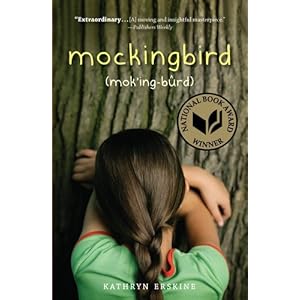 I am a bit of a book fanatic. In my spare time I cruise over to bookstores. I often say I'm just browsing, but I will typically walk away with 5-10 books to bring back to my classroom. Part of that is because I have a running list of books I want to pick up. I've scoured Newbery lists, Young Readers Choice, Global Reading Challenge, etc looking for new books to get. Sometimes I have that list physically, but more often not.
Mockingbird has been on my list for about a year now. It was out in hardcover (fun fact: I really dislike hardcover books- size, weight, cost!) and I was to get it from the library. Yeah, that didn't happen. Instead I waited until it was in paper to get it. When that happened, I immediately purchased it. Time was short, so I did what I always do: pushed it towards some of my kids allowing them to be the litmus test. The early reviews from them were very positive... so it ended up on my summer reading list.
The story is about a girl with Asperger's. Her family has just been befallen by a second tragedy. First was the passing of her mother due to cancer, and the second is the passing of her brother after a school shooting. Her trouble has less to do with his death, and more to do with the emotion that everyone says she is supposed to have. Being on the autism spectrum, she struggles when things aren't black and white.
Over the course of this story you get a small glimpse into what might be happening for someone with this disability. Processing things that take nuance and finesse are incredibly difficult, and making friends is hard. Couple those with the tragedy those around you are dealing with (and you too, but in a different way) and you have a mountain to climb. While the subject matter is touchy, heart wrenching in fact, the power of seeing our main character (Caitlin) work to overcome these many struggles was incredible. I'm really excited to have other kids read it.
Rating: 5 out of 5. It didn't win the National Book Award for nothing I guess.
Thursday, June 30, 2011
The Maze Runner by James Dashner
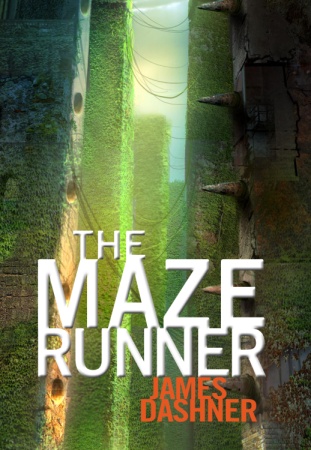 Earlier this year, I had one or two students reading the Maze Runner. I looked at the back cover and read the description, and was certainly intrigued. It was definitely going onto my list of books to read this summer. I just needed to go buy it!
Well I purchased it a week ago, and was excited to tear into it. Part of the reasoning was because it was part of the Young Readers Choice Awards, a Nominee for 2012 in the Intermediate category (more on that later). After finishing it, I really enjoyed it. I just need to figure out if I am going to bring it into my classroom (and when!).
Synopsis: There is a maze. No one knows where it is, why it is there, or how anyone has gotten there. There are boys in the maze. One comes out of this box (think elevator shaft that transports them there) every month. There are also things called grievers that come out at night and can shock or kill. Oh... and no one has any previous memory, as it appears to have been wiped clean.
Then a boy named Thomas arrives. All is the same, he has lots of questions, and life continues on. Thomas has hazy, fleeting feelings that he remembers something about this place. Everything changes the following day... a girl arrives, which is odd for two reasons: 1) no girl has ever arrived and 2) it breaks up the two year pattern of one person, once a month. From there you can say the book gets running. Thomas yearns to become a runner, someone that maps the maze looking for an exit. He gets his chance after saving two boys trapped in the maze. His skills are needed as their world appears to be rapidly speeding towards a conclusion. I'll save any more, for fear of giving away too much.
I liken the book to the Hunger Games. This past year I didn't bring out the Hunger Games until January because it was so advanced. I'll likely do the same with the Maze Runner. There are elements of the book that I question (example: they save shuck it, which is an obvious allusion to the curse). That being said, I felt like the same conversations I had with kids about the Hunger Games would apply here.
Rating: 4.5 out of 5 (lost the .5 because of the shuck it business mentioned above).
Sunday, June 26, 2011
Top 5 Books: 2010-11 edition
I pushed books on my kids like there was no tomorrow. I'd purchase books, read them, and then really get kids into them. They, in turn, recommended them to their friends. Using informal observations of which books magically came back on the last day, along with what I saw kids reading, here were the Top 5 from the 2010-11 school year.
1) Percy Jackson series- in particular the Last Olympian (since it came out in paperback this year).
2) The Hunger Games- the first book was most popular, but the second one also made the rounds. Some made it to Mockingjay, but it was certainly the least popular of the bunch.
3) Warriors- Whoa. Not a huge cat fighting, personification type of person, but this was huge in my classroom.
4) Guardians of Ga'hoole- Same as Warriors to some extent... but with owls.
5) The Kane Chronicles- Red Pyramid and Throne of Fire were huge hits. I am not sure I saw the former in my room after the first month. It just circulated!
Honorable Mention: The Lost Hero (Riordan is well liked in my classroom), When You Reach Me, Moon Over Manifest, Al Capone Does My Shirts, and Found (Sent and Sabotaged by Haddix were also well liked... this was particularly liked).
1) Percy Jackson series- in particular the Last Olympian (since it came out in paperback this year).
2) The Hunger Games- the first book was most popular, but the second one also made the rounds. Some made it to Mockingjay, but it was certainly the least popular of the bunch.
3) Warriors- Whoa. Not a huge cat fighting, personification type of person, but this was huge in my classroom.
4) Guardians of Ga'hoole- Same as Warriors to some extent... but with owls.
5) The Kane Chronicles- Red Pyramid and Throne of Fire were huge hits. I am not sure I saw the former in my room after the first month. It just circulated!
Honorable Mention: The Lost Hero (Riordan is well liked in my classroom), When You Reach Me, Moon Over Manifest, Al Capone Does My Shirts, and Found (Sent and Sabotaged by Haddix were also well liked... this was particularly liked).
Wednesday, June 22, 2011
Bittersweet Symphony
School ended today. I will admit that I was running on fumes as we reached the finish line. Scoring the social studies CBA (classroom based assessments), reading assessments, and writing assessments left me drained. 65 assessments each, give or take a few, making for a huge strain on the brain. Add to that a field trip, whole school talent show, and end of year party and you've got a very tired teacher.
I was sad to see the kiddos go. Some of our kids from last year visited us again, and were sad to be leaving. Our kids this year were a good group also, and were sad to go (but excited for summer!). We were sad to see them go. But onward to summer. I have a few things to accomplish, and below is a tentative list....
I was sad to see the kiddos go. Some of our kids from last year visited us again, and were sad to be leaving. Our kids this year were a good group also, and were sad to go (but excited for summer!). We were sad to see them go. But onward to summer. I have a few things to accomplish, and below is a tentative list....
- Clean my computer files- tomorrow!
- Clean all my paper files- tomorrow!
- Do some room re-arranging- tomorrow... or in August.
- Reflect on the school year- tomorrow or Friday (wrap it up! Blog about it tomorrow)
- Do some professional reading (Guiding Reading and Writers by Fountas and Pinnell is high on my list, as is going through the Writer's Workshop books, and Reader's Workshop books)... mid/late July!
- Read 2+ kids books a week... reviews to come. Only way to stay current!
Tomorrow I'll put a wrap on the year by going through some of the kids' reflections. From there it is time to relax and not think about school for a bit!
Sunday, June 5, 2011
Angling Towards the Finish
We're 2.5 weeks out from the finish of the school year. There is quite a bit to accomplish in the coming weeks: 2 sets of assessments, pushed back this late because of state testing; a field trip; a grade level party; grades and comments! This week is going to be tough!
The first order of business is going to be scoring the CBAs. I have scored 11 of the 13 I've received, and plan to finish the other 2 shortly. I'll get the other 52 tomorrow, which means I'll need to budget my time wisely. The upside is that I need to administer the Spring Writing Assessment, which will take 2 days (why two days- I need to have all the kids participate, and I see them for an hour per day... so 2 days!). During those times I'll score CBAs, hopefully getting through all of them by Thursday (13 per day, although likely 5-6 on Monday and 15 per day the other three days).
After the CBA commenting and scoring comes the writing assessment grading. That will take place Friday and over the weekend. The major difficultly in that is the amount of time it takes to read and thoughtfully comment. Checking the writing against the rubric is fairly easy after you've gotten into a groove of 3 or 4. But writing comments is a bear, largely because commenting needs to be specific and useful to the writer. Good job and needs work are too vague to really make an impression. I'll admit that part of me is conflicted because the kids often look at the score and disregard the comments, but that is for an entirely different post.
The last thing I "need" to do is get back to reading kids books. Kid lit is fantastic, and was a huge focus for 3/4 of the year. But I'm more than a little tired. Reading kids books, while enjoyable, reminds me of what I need to do for my kids. That is great... but a little exhausting in June.
Two and a half weeks. Lots of to do. I definitely need to make time count.
The first order of business is going to be scoring the CBAs. I have scored 11 of the 13 I've received, and plan to finish the other 2 shortly. I'll get the other 52 tomorrow, which means I'll need to budget my time wisely. The upside is that I need to administer the Spring Writing Assessment, which will take 2 days (why two days- I need to have all the kids participate, and I see them for an hour per day... so 2 days!). During those times I'll score CBAs, hopefully getting through all of them by Thursday (13 per day, although likely 5-6 on Monday and 15 per day the other three days).
After the CBA commenting and scoring comes the writing assessment grading. That will take place Friday and over the weekend. The major difficultly in that is the amount of time it takes to read and thoughtfully comment. Checking the writing against the rubric is fairly easy after you've gotten into a groove of 3 or 4. But writing comments is a bear, largely because commenting needs to be specific and useful to the writer. Good job and needs work are too vague to really make an impression. I'll admit that part of me is conflicted because the kids often look at the score and disregard the comments, but that is for an entirely different post.
The last thing I "need" to do is get back to reading kids books. Kid lit is fantastic, and was a huge focus for 3/4 of the year. But I'm more than a little tired. Reading kids books, while enjoyable, reminds me of what I need to do for my kids. That is great... but a little exhausting in June.
Two and a half weeks. Lots of to do. I definitely need to make time count.
Monday, May 30, 2011
To Do List
It is Memorial Day and I'm working. What is on my to do list? Good question.
- Processing receipts for reimbursement- I have an Excel spreadsheet to track all my school expenditures, but I like to double check.
- Reading 65 current event summaries- We had an in class reading/summary current event on the coming end of NASA's shuttle program. Now I need to read, comment, score, and enter into the online gradebook.
- Find a few more resources for some of the CBA topics- some kiddos are coming up empty on the research front, and not because they aren't trying.
- Re-map out this week- I typically map out my weeks a week or more in advance. In this case I need to re-evaluate where we are in our CBA, and what needs to happen in order to be sure we are successful.
- Re-map out next week- Stuff gets pushed around, so I need to see where some of the assessment work needs to be placed in order to make sure it ends up in the gradebook (and on the report card). Assessments include the district writing prompt for Spring, and our Spring Reading Assessment.
- Make a first pass at report card comments- I've got 16 days until report card comments and grades are due... knowing I have writing and reading assessments to score/comment, and CBAs to read/score/comment, I better get cracking.
Not too much. Just enough to keep me busy, right?
Sunday, April 24, 2011
Persuade Me
I am in the midst of finishing my pre-American Revolution unit. Kids get a feel for the colonies, what types of jobs are available, and how they were different. Then they get a feel for why the colonists want to split from Great Britain- things like the Stamp Act, the Boston Massacre, and the Boston Tea Party. The last section, before diving into the American Revolution, are some speeches for and against independence.
The oddity of this unit is that the kids know the ending: the colonies split (hooray) and win independence (double hooray). The nitty gritty they don't know, nor do they necessarily need to know in 5th grade (bits for sure). But the broader aspects are where they often hold complete fallacies. For example, most of my kids thought that everyone thought slavery was bad (not true- although I am glad they hold that sentiment now, good starting point). Most thought that a majority of people were patriots wanting independence ("Come'n, who wants to pay taxes on paper items?!").
One of the pieces we are doing is a dual reading/writing one. I had kids pick 1's and 2's, then had one student pick a piece of paper out of a bucket. There were two papers in the bucket, and the one she drew was the side (and other's with her number) needed to represent in a bit of speech writing. Why assigned a side? Well we know how it ends, right? Wouldn't you want to be on the winning side too? The excitement in the room when people were drafted into the loyalist and patriot camp was fantastic. It really set the tone for their research since all of them want to have really persuasive speeches. Hopefully that will carry into this week, and some great work and speeches.
The oddity of this unit is that the kids know the ending: the colonies split (hooray) and win independence (double hooray). The nitty gritty they don't know, nor do they necessarily need to know in 5th grade (bits for sure). But the broader aspects are where they often hold complete fallacies. For example, most of my kids thought that everyone thought slavery was bad (not true- although I am glad they hold that sentiment now, good starting point). Most thought that a majority of people were patriots wanting independence ("Come'n, who wants to pay taxes on paper items?!").
One of the pieces we are doing is a dual reading/writing one. I had kids pick 1's and 2's, then had one student pick a piece of paper out of a bucket. There were two papers in the bucket, and the one she drew was the side (and other's with her number) needed to represent in a bit of speech writing. Why assigned a side? Well we know how it ends, right? Wouldn't you want to be on the winning side too? The excitement in the room when people were drafted into the loyalist and patriot camp was fantastic. It really set the tone for their research since all of them want to have really persuasive speeches. Hopefully that will carry into this week, and some great work and speeches.
Saturday, April 9, 2011
Library Cards
I had a student yesterday who asked: "Mr. Hanson, can I still borrow books from your library next year?" I replied, "Sure you can. You're always welcome to borrow my books." To which the student said, "Good, because you have a lot of books I still want to read and I'm not sure they'll have them in 6th grade."
If there is one thing I have worked hard to do, it is maintaining my classroom library. I have a shelf in the front of the room with "new books" which are either new or new to my classroom. To have kids talking about books, asking me what they should read next, and an exchange like that above, couldn't make me any happier. There were kids who weren't excited about reading before this year that are plowing through whole series' of books. It makes me excited to go find some more books!
Saturday, March 12, 2011
Novel Study Take Two
I'm running a second round of novel study. This time around I've changed it up. Many of my concerns were expressed here. Running groups with 65 kids is challenging, there isn't much of an alternative. While I've seen whole classes read the same book, I'm not sure I could make that work in my classroom. The variance in reading levels makes it quite challenging.
What has changed this time around? The reading kids need to do happens mainly at home. I provide one 15 minute block for kids to read, but they are otherwise expected to get it done for homework. I went through the math with 2 or 3 kids that said they didn't have time, and they actually have close to 2 hours during the week AT SCHOOL to get it done (time in the morning, afternoon, and when we transition- reading as a settling activity we have all kids do). I've also taken away many of the other pieces of homework so that they have a focus on the reading.
What else has changed? I am having kids do discussion questions (3 of them) before meeting with their group. Previously it was one kid responding on paper for their group, and it never gave me a real eye into their thinking (duh, that was the point!). Looking at their response sheets, and listening to their groups, I was really excited about the change. Kids who said "I didn't understand that" were coming to a better understanding. Kids were excited to talk about their books with each other. I also felt like it was more equitable since everyone had something to contribute.
I'll continue to tweak. But for now, a good start. Lots to do heading into Spring Break!
What has changed this time around? The reading kids need to do happens mainly at home. I provide one 15 minute block for kids to read, but they are otherwise expected to get it done for homework. I went through the math with 2 or 3 kids that said they didn't have time, and they actually have close to 2 hours during the week AT SCHOOL to get it done (time in the morning, afternoon, and when we transition- reading as a settling activity we have all kids do). I've also taken away many of the other pieces of homework so that they have a focus on the reading.
What else has changed? I am having kids do discussion questions (3 of them) before meeting with their group. Previously it was one kid responding on paper for their group, and it never gave me a real eye into their thinking (duh, that was the point!). Looking at their response sheets, and listening to their groups, I was really excited about the change. Kids who said "I didn't understand that" were coming to a better understanding. Kids were excited to talk about their books with each other. I also felt like it was more equitable since everyone had something to contribute.
I'll continue to tweak. But for now, a good start. Lots to do heading into Spring Break!
Thursday, February 17, 2011
Books to Read
Today is the start of midwinter break. We stretch it out from Thursday to Monday, and get back after it on Tuesday. I really dislike taking time off. While I know I need the physical and mental break, I still find it difficult to break away. This break is no different. So what is on tap? Lots of reading. Some of the books I want to tackle include:
- A Week in the Woods- Andrew Clements
- The True Confessions of Charlotte Doyle- Avi (never read any Avi, so it needs to be done!)
- The Breadwinner- Deborah Ellis
- Bridge to Terabithia- Katherine Paterson
- Hatchet- Gary Paulsen
- The Westing Game- Ellen Raskin
- Mixed Up Files of Mrs. Basil E. Frankweiler- Konigsburg
- Bud, Not Buddy- Curtis
- Maniac Magee- Spinelli
Most of the above I have skimmed (or read in the case of Frankweiler, Bridge) but want to go through in the case I want to use them for future novel study. I've also go Mockingbird by Erskine, and Catching Fire (Hunger Games) by Collins to tackle as I want to keep reading stuff that I want kids to pick up independently. Books books books! Not a bad way to spend my break.
Tuesday, February 15, 2011
Running Novel Study Groups
The greatest challenge in our novel study is balancing the varying rates of readers. You have some kids that read slowly (sub 120 words per minute), while you have others that read significantly faster. You balance that against kids that have a greater propensity to read than others as well. That doesn't even get into the variance in comprehension, which is not entirely correlated with reading rate.
I've struggled balancing out my groups. I'll give kids books that they are interested in, but not always the one they are most excited about- seeing some books as an opportunity to challenge kids. Between getting excited about books they weren't pumped about, monitoring comprehension of readers of all rates, and keeping fast readers invested in novel study... there is quite a bit to take care of.
One wrinkle I am considering changing is actually an addition. Currently I have bi-weekly literature circle groups. In those groups kids will respond to 2-3 questions (largely inferential or analytical) with their peers (those reading the same book). That is fantastic, but the other weeks miss that same response element. They have a response to do for their novel study packet, but I would like to use the same questions from their literature circle on non-lit circle days. What is stopping me? The additional writing that the kids would need to do- I don't want reading to be a constant chore ("I need to write now that I have read"). It isn't what real readers do. By the same token I need to monitor comprehension, particularly with some of the symbolic messages authors embed in their respective works. Ah, the joy of running novel study groups!
I've struggled balancing out my groups. I'll give kids books that they are interested in, but not always the one they are most excited about- seeing some books as an opportunity to challenge kids. Between getting excited about books they weren't pumped about, monitoring comprehension of readers of all rates, and keeping fast readers invested in novel study... there is quite a bit to take care of.
One wrinkle I am considering changing is actually an addition. Currently I have bi-weekly literature circle groups. In those groups kids will respond to 2-3 questions (largely inferential or analytical) with their peers (those reading the same book). That is fantastic, but the other weeks miss that same response element. They have a response to do for their novel study packet, but I would like to use the same questions from their literature circle on non-lit circle days. What is stopping me? The additional writing that the kids would need to do- I don't want reading to be a constant chore ("I need to write now that I have read"). It isn't what real readers do. By the same token I need to monitor comprehension, particularly with some of the symbolic messages authors embed in their respective works. Ah, the joy of running novel study groups!
Saturday, December 25, 2010
Imagine Nation
 Merry Christmas!
 If you go back to last year, I set out to do a little bit of work curriculum mapping. In truth, I did some work but probably not as much as I'd have hoped. I did a little bit on Thursday, and I was really productive. But I've also been doing a ton of reading (on book 4 of the break!)
In the spirit of giving I figured I'd pass along a fantastic book to read. If you read one book in the next month, read Jack Blank and the Imagine Nation. I was never much of a comic book fan, but the book (which centers around comics) is wonderful. Short synopsis: orphan boy gets kicked out of boarding school, and taken to a mysterious island (the Imagine Nation). Turns out he is infected with a robot (Rustov) virus that the nation fears, but they agree to test him (and two others) to join the prestigious School of Thought. He goes through testing, leading to an epic finale centered around good, evil, and the notion of destiny.
I really enjoyed the themes that were woven into the story. The ideas of good/evil are clearly evident, yet not overpowering. You also clearly see the idea of using your imagination, and believing in yourself. Obviously kids aren't always as aware of these themes (part of a teacher's job, and the idea of exposure), I feel like these themes clearly come through in the end. Total must read. Next up is Ring of Fire (#1).
Subscribe to:
Posts (Atom)