Just before spring break my kids finished their Social Studies CBA. It is a big project involving research on a topic, and analyzing information. Many of the pieces of reading- news articles, websites- are above grade level, adding to the challenge.
The work that kids produced was really great. Having done this 3 years prior, this was probably the best of the years as far as overall work kids produced. Instead of basking in the glow of good work, I wondered why the work was better. What made year 4 that much better than year 3, etc.?
I was more intentional with the skills kids would need to use. Being able to write a thesis statement is important, and we modeled doing that. Making inferences from quotes- another challenging skill. Analyzing all of the possible solutions- kids previously were locked into their solution. Instead, they were asked to see all viewpoints- and we tackled modeling that as a whole group. Another part of the success is embedding news articles in our weekly work (er, bi-weekly maybe). I asked kids to pick sides on issues during the year as well as analyzing points of view. When they see the CBA in March it ends up being less of an ordeal.
I still think there is room for growth. We found lots of statistical information... But we struggled interpreting it. Things like car emissions or accidents texting while driving were inserted with the "as you can see..." sort of line that assumes you can read the graph. Next time we'll actually write about the meaning of the data. But for now- job well done.
Showing posts with label CBA. Show all posts
Showing posts with label CBA. Show all posts
Wednesday, April 24, 2013


Saturday, March 23, 2013
Literacy and Worksheets
My kids are working on issue research. They research and unpack the many points of view that comprise an issue. One student is working on paper usage in the US. This is similar to a topic done last year that focused on paper use in schools.
The big "A-Ha" for me was literacy and worksheets don't really mesh. In fact, I'd argue that if you're making a ton of worksheets for your literacy time (in the intermediate classroom :) you're in fact wasting your time (and your kids' time). Kids need the opportunity to real have authentic conversations about books, and record their thoughts. Countless packets of "stuff"? No. You can teach concepts that they record in journals- or that go on charts in your room. But daily spelling practice? Grammar work? You can do those in other ways without the class set of copies.
Next time you're heading to the copier think: is there another way that gets this done and meets the needs of my kids? I bet you'll say yes.
The big "A-Ha" for me was literacy and worksheets don't really mesh. In fact, I'd argue that if you're making a ton of worksheets for your literacy time (in the intermediate classroom :) you're in fact wasting your time (and your kids' time). Kids need the opportunity to real have authentic conversations about books, and record their thoughts. Countless packets of "stuff"? No. You can teach concepts that they record in journals- or that go on charts in your room. But daily spelling practice? Grammar work? You can do those in other ways without the class set of copies.
Next time you're heading to the copier think: is there another way that gets this done and meets the needs of my kids? I bet you'll say yes.
Thursday, March 1, 2012
We've Got Issues
We're in the midst of our 5th grade CBA- curriculum based assessment. In this they need to select an issue, research it, analysis positions, and call for action. The project is ambitious, but worthwhile. My understanding is that some classes will do this as a stand alone assessment, and it will take 2-3 days.
I've taken to teaching this as a unit on issues. We'll discuss issues in our local community, go through what stakeholders are, and determine how we filter out information. We started earlier in the week by looking at a road near school that is ridiculously busy yet had no sidewalks. Instead it has a painted line as separation- helpful I suppose. We went through why this is a problem, who might care, and what could be done. Afterwards I modeled using search engines and our research databases (god help me if we type I the question again!!!).
How is it going? We're slowly moving the horse. Some are really pumped, and want to employ all of these skills. Others say "I'm not sure what issue to do can you pick one" or "there aren't any issues that impact me." The latter of those statements is particularly frustrating. They will say that we use too much paper or that school lunch doesn't taste good and turnaround to say those issues aren't a big deal to them. I will steer them into a choice between issues and let them do the rest, as it isn't my project (I already know that I can think about issues). My focus needs to be on pushing all of them, even those disinterested, to analyze information and explain. You can't say what should be done just because you think it sounds good!
I've taken to teaching this as a unit on issues. We'll discuss issues in our local community, go through what stakeholders are, and determine how we filter out information. We started earlier in the week by looking at a road near school that is ridiculously busy yet had no sidewalks. Instead it has a painted line as separation- helpful I suppose. We went through why this is a problem, who might care, and what could be done. Afterwards I modeled using search engines and our research databases (god help me if we type I the question again!!!).
How is it going? We're slowly moving the horse. Some are really pumped, and want to employ all of these skills. Others say "I'm not sure what issue to do can you pick one" or "there aren't any issues that impact me." The latter of those statements is particularly frustrating. They will say that we use too much paper or that school lunch doesn't taste good and turnaround to say those issues aren't a big deal to them. I will steer them into a choice between issues and let them do the rest, as it isn't my project (I already know that I can think about issues). My focus needs to be on pushing all of them, even those disinterested, to analyze information and explain. You can't say what should be done just because you think it sounds good!
Sunday, June 5, 2011
Angling Towards the Finish
We're 2.5 weeks out from the finish of the school year. There is quite a bit to accomplish in the coming weeks: 2 sets of assessments, pushed back this late because of state testing; a field trip; a grade level party; grades and comments! This week is going to be tough!
The first order of business is going to be scoring the CBAs. I have scored 11 of the 13 I've received, and plan to finish the other 2 shortly. I'll get the other 52 tomorrow, which means I'll need to budget my time wisely. The upside is that I need to administer the Spring Writing Assessment, which will take 2 days (why two days- I need to have all the kids participate, and I see them for an hour per day... so 2 days!). During those times I'll score CBAs, hopefully getting through all of them by Thursday (13 per day, although likely 5-6 on Monday and 15 per day the other three days).
After the CBA commenting and scoring comes the writing assessment grading. That will take place Friday and over the weekend. The major difficultly in that is the amount of time it takes to read and thoughtfully comment. Checking the writing against the rubric is fairly easy after you've gotten into a groove of 3 or 4. But writing comments is a bear, largely because commenting needs to be specific and useful to the writer. Good job and needs work are too vague to really make an impression. I'll admit that part of me is conflicted because the kids often look at the score and disregard the comments, but that is for an entirely different post.
The last thing I "need" to do is get back to reading kids books. Kid lit is fantastic, and was a huge focus for 3/4 of the year. But I'm more than a little tired. Reading kids books, while enjoyable, reminds me of what I need to do for my kids. That is great... but a little exhausting in June.
Two and a half weeks. Lots of to do. I definitely need to make time count.
The first order of business is going to be scoring the CBAs. I have scored 11 of the 13 I've received, and plan to finish the other 2 shortly. I'll get the other 52 tomorrow, which means I'll need to budget my time wisely. The upside is that I need to administer the Spring Writing Assessment, which will take 2 days (why two days- I need to have all the kids participate, and I see them for an hour per day... so 2 days!). During those times I'll score CBAs, hopefully getting through all of them by Thursday (13 per day, although likely 5-6 on Monday and 15 per day the other three days).
After the CBA commenting and scoring comes the writing assessment grading. That will take place Friday and over the weekend. The major difficultly in that is the amount of time it takes to read and thoughtfully comment. Checking the writing against the rubric is fairly easy after you've gotten into a groove of 3 or 4. But writing comments is a bear, largely because commenting needs to be specific and useful to the writer. Good job and needs work are too vague to really make an impression. I'll admit that part of me is conflicted because the kids often look at the score and disregard the comments, but that is for an entirely different post.
The last thing I "need" to do is get back to reading kids books. Kid lit is fantastic, and was a huge focus for 3/4 of the year. But I'm more than a little tired. Reading kids books, while enjoyable, reminds me of what I need to do for my kids. That is great... but a little exhausting in June.
Two and a half weeks. Lots of to do. I definitely need to make time count.
Monday, May 30, 2011
To Do List
It is Memorial Day and I'm working. What is on my to do list? Good question.
- Processing receipts for reimbursement- I have an Excel spreadsheet to track all my school expenditures, but I like to double check.
- Reading 65 current event summaries- We had an in class reading/summary current event on the coming end of NASA's shuttle program. Now I need to read, comment, score, and enter into the online gradebook.
- Find a few more resources for some of the CBA topics- some kiddos are coming up empty on the research front, and not because they aren't trying.
- Re-map out this week- I typically map out my weeks a week or more in advance. In this case I need to re-evaluate where we are in our CBA, and what needs to happen in order to be sure we are successful.
- Re-map out next week- Stuff gets pushed around, so I need to see where some of the assessment work needs to be placed in order to make sure it ends up in the gradebook (and on the report card). Assessments include the district writing prompt for Spring, and our Spring Reading Assessment.
- Make a first pass at report card comments- I've got 16 days until report card comments and grades are due... knowing I have writing and reading assessments to score/comment, and CBAs to read/score/comment, I better get cracking.
Not too much. Just enough to keep me busy, right?
Wednesday, May 25, 2011
A Promising Start
Two of my three groups have started the CBA. I anticipate it taking until next Friday with a few extensions mixed in. For a few there will be some simplification- narrowing of topics, resources in order to help with problem solving. While a wide net allows for student choice, it does not help those students that struggle organizing information or getting started (a broad array of choices can be overwhelming).
For the two that started, so far so good. I have gone through discussing issues and possible solutions. I've had students collaborate on solutions, and discuss compromises since not all people want it solved in the same way. We got off to a slow start, but a vast majority of kids have workable issues and understand who some of the stakeholders are on each side. From there they had some freedom to search on their own prior to the guided research lesson.
Research and culling information from articles looks like it will be the most difficult piece. My experience has been that we (meaning those who are under the age of 35 +/- a few years) are not the most patient bunch. We see something and want the answer before us. What is with this writing to explain both sides stuff?! It is increasingly so the younger you get (I know, painting with a broad brush). Reading a 2 page article on recycling, particularly when I am not versed in the intricacies of the concept, is yawn inducing and difficult. Tomorrow we are going to take our issue and write it as a question, then look at keywords associated with that question:
Issue: Recycling
Question: Should people recycle more than they do?
Keywords: recycling, increase, decrease, amount, recycling program, garbage, trash, cities, people
From there I am going to model searching... We'll find an article that looks good, but doesn't work (by reading the first 2 paragraphs... then skimming for the keywords, since our search program highlights the keywords). Then we'll find one that does work (same process), and work to cull out 2-3 key sentences before bookmarking for future reading. My objective is that they can analyze sources for relevance to their topic, so it should be an interesting day of research.
For the two that started, so far so good. I have gone through discussing issues and possible solutions. I've had students collaborate on solutions, and discuss compromises since not all people want it solved in the same way. We got off to a slow start, but a vast majority of kids have workable issues and understand who some of the stakeholders are on each side. From there they had some freedom to search on their own prior to the guided research lesson.
Research and culling information from articles looks like it will be the most difficult piece. My experience has been that we (meaning those who are under the age of 35 +/- a few years) are not the most patient bunch. We see something and want the answer before us. What is with this writing to explain both sides stuff?! It is increasingly so the younger you get (I know, painting with a broad brush). Reading a 2 page article on recycling, particularly when I am not versed in the intricacies of the concept, is yawn inducing and difficult. Tomorrow we are going to take our issue and write it as a question, then look at keywords associated with that question:
Issue: Recycling
Question: Should people recycle more than they do?
Keywords: recycling, increase, decrease, amount, recycling program, garbage, trash, cities, people
From there I am going to model searching... We'll find an article that looks good, but doesn't work (by reading the first 2 paragraphs... then skimming for the keywords, since our search program highlights the keywords). Then we'll find one that does work (same process), and work to cull out 2-3 key sentences before bookmarking for future reading. My objective is that they can analyze sources for relevance to their topic, so it should be an interesting day of research.
Tuesday, May 17, 2011
Sidewalk Art
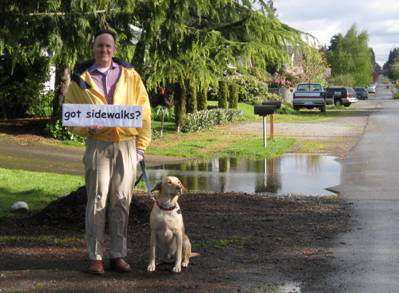
Got sidewalks? Parts of my neighborhood don't (as seen to the left... although that is from flickr and isn't me!). An image like that one to the left is going to be the opener for my CBA. As part of the guided release process we will do some visual discovery using 1-2 images from my neighborhood. From there we'll talk about questions we wonder about, and if there is an issue depicted. The natural progression should be: I see a place without sidewalks, the issue is whether all neighborhoods should have sidewalks. People need to be safe when walking around their neighborhood.
I really like the state CBA. It asks kids to ponder current issues by thinking about stakeholders, and how rights or the common good are impacted. The key is effective modelling. Kids need to see how to brainstorm different issues, research different points of view, and put it together in order to persuade others to see your position. We've worked at length regarding seeing multiple points of view, but it can be difficult applying it to a new setting that is more open-ended. I'll likely give lots of freedom, but enough structure that kids see where we are going. Graphic organizer? Yep, you need to use it. Presentation format? Yep, needs to be PowerPoint, brochure, or essay. Can you do any issue? Sure (although guns, death penalty, and drugs are out- those not school appropriate). Will some kids need more monitoring and guidance? Yep. You just need to know who those kids are.
Sunday, May 15, 2011
CBA Launch
The Constitution and the Bill of Rights are next on my list. Instead of some of the in-depth work that I wanted to do, I am doing more simplistic reading comprehension work. As I mapped out the final few weeks I saw how little time I really allotted for the CBA. I expected that the question formulation, research, drafting, revising, and completion would take 2 weeks. It should... but not when the 2 weeks have other odds and ends mixed in (like Memorial Day, Field Day, Talent Show, etc). Ugh!
The solution is to condense a few things in order to ensure enough time to finish the CBA in an appropriate amount of time. The goal is to go over branches of government and talk about rights, with a progression into particular issues that kids brainstorm. We'll start the brainstorming together, using a WCYDWT sort of thing. There are a few different approaches I am tossing around. One might be 2-3 images (something like the arrival of construction equipment, a map, and blueprint) and 1-2 questions for kids to wrestle with- how might this impact the community? what are the positives/negatives of this event?. Another idea is to have one image (something like open green space, or a wetland) and start entirely from scratch- what does this image make you think of? how is this image important to the community? I am not 100% how I want to approach it, but I do know that the latter was done (by me) and was successful in some ways.
The ultimate goal is to get kids wondering about issues around them. I want kids to ask questions that naturally lead them into research, and naturally lead them into supporting/refuting their opinion. I do know that I am going to restrict the presentation formats. Just because you have access to 8 or 9 different platforms doesn't mean you need to use all of them. I've got 7-10 instruction days left before it starts. Should be fun!
The solution is to condense a few things in order to ensure enough time to finish the CBA in an appropriate amount of time. The goal is to go over branches of government and talk about rights, with a progression into particular issues that kids brainstorm. We'll start the brainstorming together, using a WCYDWT sort of thing. There are a few different approaches I am tossing around. One might be 2-3 images (something like the arrival of construction equipment, a map, and blueprint) and 1-2 questions for kids to wrestle with- how might this impact the community? what are the positives/negatives of this event?. Another idea is to have one image (something like open green space, or a wetland) and start entirely from scratch- what does this image make you think of? how is this image important to the community? I am not 100% how I want to approach it, but I do know that the latter was done (by me) and was successful in some ways.
The ultimate goal is to get kids wondering about issues around them. I want kids to ask questions that naturally lead them into research, and naturally lead them into supporting/refuting their opinion. I do know that I am going to restrict the presentation formats. Just because you have access to 8 or 9 different platforms doesn't mean you need to use all of them. I've got 7-10 instruction days left before it starts. Should be fun!
Monday, June 14, 2010
Realizations- CBA edition
I'm in the midst of evaluating our CBAs. I'm reading their work (most of which are powerpoints), checking their self-evaluations (OSPI rubrics), and providing feedback. The process is somewhat tedious, and certainly frustrating. Why? There isn't a way for us to go back and make changes to improve them is one reason. The second is that many of the errors are a result of revision, or lack thereof. Items on the graphic organizer that didn't make it into the presentation.
Ultimately I have some changes to make to the process. First, we'll start it in April instead of late May. We'll have an outline of the days, and what work will be done each day (at least at the start).
Ultimately I have some changes to make to the process. First, we'll start it in April instead of late May. We'll have an outline of the days, and what work will be done each day (at least at the start).
- Monday 4/5- Research using search terms- find one article on elibrary/print
- Tuesday 4/6- Research using search terms- find one useful website/print
- Wednesday 4/7-Deciphering research- what to use.
While we had our specific days, with explicit purposes for each, some of the points were lost in translation. Ultimately the goal is to ensure that they are successful, which providing some of those scaffolds will do.
We'll also do another WCYDWT sort of thing. That, to me, was how I started off the CBA. We started with an image and talked about it, wondered about it, gathered more information, then started on a trajectory towards putting something together. We struggled with the process of utilizing our research to the fullest extent possible. Using pictures, particularly current events stuff, is right up the "what can you do with this" alley. Kids want to know more, and want to try and make sense of the world around them. They just need the tools to do it, which requires reading, writing, and research. If I had a rewind button I'd be hitting it, putting it on 5x fast.
Monday, May 24, 2010
The Wheels on the Bus
There are some things teachers don't do well, myself included. One of those areas is "search" or "research" or data/information accumulation. Here is a common sequence of events for my kids as they tackle their CBA:
- Issue: Wetlands/Conservation
- Essential Question: Should wetlands be protected or developed?
- Search (via Search engine): "Should wetlands be protected?"
- Search Result: Some sites including WikiAnswers.com... followed by
- Student Action: copy, paste into Word/PowerPoint slide, possible rephrasing (certainly upon teacher questioning)
- Student Question (to teacher): So am I done yet? I've done all my research.
Granted, this is not each and every student, but this is a very common occurrence and leads me to the supposition found above. Now, I could be happy with the fact that they are crafting genuine questions about topics of interest. I could also be happy, and perhaps even satisfied, that they are doing any research. But that just isn't my style.
To tackle that I illustrated how to search, albeit in a manner that was still not as in depth as I'd like (time constraints). First I started with a discussion about search terms, generating multiple terms that were derived from their questions and stakeholders. From there we went into their method- just type in your question and hope for the best! We agreed that this was not quite the most efficient method, and didn't always yield the greatest results. Instead we tried different terms, and we tried different search engines along with a large district research database. Viola! The transformation was HUGE, making a big difference in the quality of information they found.
I'll take it as a huge victory considering the time constraints. We need to ration our time, and undoing some bad habits that have festered just isn't the highest of priorities. Undoing the "we were told to copy and paste then rewrite in our own words" (note: my quotes, not theirs) message is paramount. As I scratched the surface of that, I found that was an instructional message some kids had received somewhere. The message is essentially: don't worry about reading it, assume you agree with the writer, copy it and paste it, and rephrase to put in your own words when you're "research is done". I nearly fell out of my chair. Give the kids a little credit, they can do the work. Expect them to do it because,ultimately they'll surprise you.
Sunday, May 23, 2010
CBA Introduction Redux
This past week I introduced our Social Studies CBA (see this post here for the plan behind it). When it was all said and done, my hope was that students would be selecting issues that genuinely concern them. The more difficult part is crafting a question related to that issue, which you'll try to address in a presentation.
I presented kids with images (Internet not original, largely due to lack of time) of wetlands. The first one looked like your standard undeveloped empty lot- a mixture of standing and fallen trees, plants, shrubbery, etc. The second one looked far closer to that of a wetland, with water and grasses mixed in. I had also brought up the point that Redmond has a growing population, illustrated by our school population increase. With those pictures, and their preliminary observations, we made the gentle leap to "What should happen to this land?" How do you accommodate the people who live there, and those that want to live there? Google Earth does a great job of providing satellite views of an area, in our case showing the vastly developed area with mixed in underdeveloped land.
The range of responses to the question above was precisely what I was aiming for. As kids traversed the possible scenarios of a wetland nature preserve and an area shopping mall, the body language (and oral response) was quite striking. "Ohhh no! You couldn't tear that down for a MALL!" Again, this was by design. We talked about who the stakeholders might be, and why they would want a say in what happens there.
Ultimately this produced some great questions...
I presented kids with images (Internet not original, largely due to lack of time) of wetlands. The first one looked like your standard undeveloped empty lot- a mixture of standing and fallen trees, plants, shrubbery, etc. The second one looked far closer to that of a wetland, with water and grasses mixed in. I had also brought up the point that Redmond has a growing population, illustrated by our school population increase. With those pictures, and their preliminary observations, we made the gentle leap to "What should happen to this land?" How do you accommodate the people who live there, and those that want to live there? Google Earth does a great job of providing satellite views of an area, in our case showing the vastly developed area with mixed in underdeveloped land.
The range of responses to the question above was precisely what I was aiming for. As kids traversed the possible scenarios of a wetland nature preserve and an area shopping mall, the body language (and oral response) was quite striking. "Ohhh no! You couldn't tear that down for a MALL!" Again, this was by design. We talked about who the stakeholders might be, and why they would want a say in what happens there.
Ultimately this produced some great questions...
- (Food in Schools) Can we make school lunches healthier?
- (Smoking in public) Can we stop people from smoking in public?
- (Smog/Greenhouse Gases) How can we lower car pollution?
- (Skateboarding) Why isn't skateboarding in public legal?
- (Gun Control) How do we keep people safe from guns?
- (Video Game Violence) Do violent video games make kids violent?
- (Drugs) How do we stop drug dealing and usage?
- (Racism) How can we stop racism?
The difficult part in this whole process is not having a preconceived argument. The kids need to work from their research instead of crafting their essays/presentations and finding research to support them. Research is also a difficult process, as it requires a degree of patience that I want them to have but that they often lack (at least to the extent that I'd like it). I am encouraged by the start, and hope that they week yields some great stuff. My guess is that, because of the other events taking place in the coming weeks, we're about done with the historical end of things. But I walk into next week cautiously optimistic.
Sunday, May 16, 2010
Social Studies CBA
As we prepare to finish our MSP testing, my focus begins to turn towards the Social Studies CBA. A CBA is a Classroom Based Assessment, and is rooted in the standards. It allows students to use the skill based sections of the standards to address content of their choice. In our case we will be using the "You Decide" CBA, which should be really neat.
What is You Decide? Essentially kids will be selecting an issue, with some teacher direction, and creating a presentation of some sort about the issue, different points of view, and possible outcomes they would propose. An example would be: Public Spaces/Parks. A student could say that more space is needed for public parks. Society at large has a vested interest in ensuring that empty land is developed into parks so that people can enjoy the outdoors and live a healthy lifestyle in their community. Those opposed might be real estate developers who want to create a retail space for a small/large businesses. In the end, the students will research the issue, form an opinion, and then create some sort of formal presentation (poster board, poster, powerpoint, Photostory, essay, etc). Essay or Powerpoint seem the easiest and most likely, but I am sure a few will opt for the more complex method.
My approach? Well I've found myself inspired by Dan Meyer and his math teaching. In particular, I've been struck by the idea of using multimedia to help kids generate their own ideas and questions. We'll use the example above, and I'll show a picture of an open space near Marymoor Park. The start will be, what do you see in this picture? The question I have in mind to bridge the gap between usage and observation is, How do you feel about this land? I have an inkling that from those feelings will come something like "I think it should be ______," which is precisely where I want them to go (without me telling them to).
Since we have Activboards, and I have a digital camera, I can also bring over some pictures of a park and a mixed-use shopping facility. They can be dragged in to fit with the image, likely evoking a mixture of emotions, which (again) is exactly what I am looking for. The point is that issues have multiple points of view with a variety of stakeholders, and all ideas must be weighed (a concept we have talked about).
I think it will be really successful, and largely student-driven. I'm excited to get started on it.
What is You Decide? Essentially kids will be selecting an issue, with some teacher direction, and creating a presentation of some sort about the issue, different points of view, and possible outcomes they would propose. An example would be: Public Spaces/Parks. A student could say that more space is needed for public parks. Society at large has a vested interest in ensuring that empty land is developed into parks so that people can enjoy the outdoors and live a healthy lifestyle in their community. Those opposed might be real estate developers who want to create a retail space for a small/large businesses. In the end, the students will research the issue, form an opinion, and then create some sort of formal presentation (poster board, poster, powerpoint, Photostory, essay, etc). Essay or Powerpoint seem the easiest and most likely, but I am sure a few will opt for the more complex method.
My approach? Well I've found myself inspired by Dan Meyer and his math teaching. In particular, I've been struck by the idea of using multimedia to help kids generate their own ideas and questions. We'll use the example above, and I'll show a picture of an open space near Marymoor Park. The start will be, what do you see in this picture? The question I have in mind to bridge the gap between usage and observation is, How do you feel about this land? I have an inkling that from those feelings will come something like "I think it should be ______," which is precisely where I want them to go (without me telling them to).
Since we have Activboards, and I have a digital camera, I can also bring over some pictures of a park and a mixed-use shopping facility. They can be dragged in to fit with the image, likely evoking a mixture of emotions, which (again) is exactly what I am looking for. The point is that issues have multiple points of view with a variety of stakeholders, and all ideas must be weighed (a concept we have talked about).
I think it will be really successful, and largely student-driven. I'm excited to get started on it.
Subscribe to:
Posts (Atom)