I made the trek to school today, a wonderful 25 minute jaunt because it wasn't rush hour. When I arrived I nearly had a heart attack. The floors were being waxed, common for this time of year in schools across the country. What in the world was I going to do? Thankfully my room opens to the outside, and the door was unlocked (courtesy of our janitor! so great!).
I was able to get quite a bit done today. When I left last week they were getting set to re-wax the tile area in my room, which needed to cure before I could move anything. That was all set, so I was able to scoot desks, tables and computers around. I moved our computers back to where they were, taping their Ethernet cords to the wall so that they are mildly inconspicuous. I unflipped the desks that were in a giant cluster, putting them into some approximation of what my classroom will look like. I was also able to return some of my instructional materials (teaching guides) that I won't need to look at in the next two weeks (at least not at home, as some of those are still in the home office). Novels were also moved on top of one of the bookcases, creating another shelf since a majority of them will sit there until used for my various novel studies.
What are the next steps? Getting the physical space looking good is a great start. Next is making notes about what content I will teach, and how I want to teach it. I also need to look at the sequence so that I am sure it makes sense. I'll make other adjustments once the year gets rolling, but you need to start somewhere.
I am using the tool which I am using for my novel study summaries, OneNote, for my curriculum planning. Instead of oodles of notebook paper that I won't refer back to, I have a document that I am excited to add and revise to. I am using a new OneNote document for each curricular area that I teach (Reading, Writing, Social Studies), with different tabs for expectations and units. Thus far I couldn't be happier.
Tuesday, August 10, 2010


Monday, August 9, 2010
Two Weeks, Really?
This has been my first summer off in many, many years. I realize how odd that sounds, as most people don't actually have summers off. That being said, I actually haven't taken much more than 2-3 days off (even during breaks, this year aside) since high school. While I have a planner, I really haven't opened it or looked at the calendar section (aside from planning my running/racing schedule).
Seeing two weeks of summer remaining is mortifying. Saying "I've got time" or "I'll do that tomorrow" is out the window, and it is replaced by "I should have done that yesterday." While I don't necessarily feel behind the eight-ball, I do sense the crush of the school year coming. The beginning of the school year work needs to get planned, and not simply the curricular work I have been focused on.
There is no time like the present.
Seeing two weeks of summer remaining is mortifying. Saying "I've got time" or "I'll do that tomorrow" is out the window, and it is replaced by "I should have done that yesterday." While I don't necessarily feel behind the eight-ball, I do sense the crush of the school year coming. The beginning of the school year work needs to get planned, and not simply the curricular work I have been focused on.
There is no time like the present.
Saturday, August 7, 2010
Organize and Save
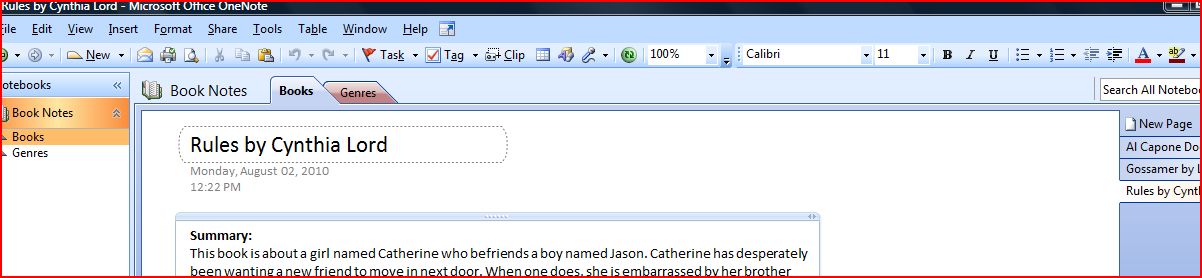 The image shows my personal experiment with OneNote. I have create a notebook with my novel study books. I knew that I wanted a place to write down summaries and questions that I could use in discussion groups or as reading response. I had previously thought about creating a Word document to store all of this information. The major problem with that is ensuring it isn't cumbersome. I want to be sure that I can go back and refer to my notes, even if I don't utilize the questions I have written down. My hope is that it will save a little bit of my planning time. You'll never guess the trouble of ensuring you've read all 4-5 books in your novel study, while also being sure you've got all of your other reading (instructional materials, social studies, current events) taken care of!
In the future I think I will include tabs for different book groups, grouped by genre or category. I've started a Genre tab, but it falls short in some of the sorting capabilities that Excel has. I have a different document in Excel that has all of my multiple copy books (or most... well, many). I can sort it by title, author, number of copies, or approximate reading level. It isn't perfect, but it definitely helps out with some of my planning.
Friday, August 6, 2010
The More You Write, the More It Grows
Over the next few days I have a ton of stuff to do. Essentially I have two weeks of freedom before professional development starts in my building. Having just been in two days of instructional materials (writing) training, I am a bit worn out. That being said, I am also excited about the possibility of further integration of writing into my Social Studies/Literacy block.
Kids do a ton of writing when they come through my room. They write down notes, and responses, to what we are reading in Social Studies. They also write down responses to literature we are reading. We do weekly current events summaries as homework. Our wiki gets used on a regular basis, and is a great chance for kids to communicate their understanding of the concepts we are learning.
All of that being said, my actual writing instruction during this block was far from optimal. Part of this lies in my mental concept of writing instruction: a writing block (writer's workshop) where kids are actively working on pieces of writing that may of may not be related to other curricular areas. I utilized the Units of Study materials, and enjoyed them (as a sidenote, I'm hoping to go to the Teacher's College next summer to do some of their PD). What I need to eliminate are the walls between writing and my social studies block. I plan to use the materials I was just trained to use to improve my kids' writing, seeing the materials as a concrete bridge to improved paragraphs, summaries, sentences, etc. Will I do away with my writer's workshop? No. I see room for both to fit in my instruction.
There is quite a bit to be done.
Kids do a ton of writing when they come through my room. They write down notes, and responses, to what we are reading in Social Studies. They also write down responses to literature we are reading. We do weekly current events summaries as homework. Our wiki gets used on a regular basis, and is a great chance for kids to communicate their understanding of the concepts we are learning.
All of that being said, my actual writing instruction during this block was far from optimal. Part of this lies in my mental concept of writing instruction: a writing block (writer's workshop) where kids are actively working on pieces of writing that may of may not be related to other curricular areas. I utilized the Units of Study materials, and enjoyed them (as a sidenote, I'm hoping to go to the Teacher's College next summer to do some of their PD). What I need to eliminate are the walls between writing and my social studies block. I plan to use the materials I was just trained to use to improve my kids' writing, seeing the materials as a concrete bridge to improved paragraphs, summaries, sentences, etc. Will I do away with my writer's workshop? No. I see room for both to fit in my instruction.
There is quite a bit to be done.
Wednesday, August 4, 2010
Inspire Me!
The big picture, pie in the sky, head in the clouds stuff is where I often live. The mechanics, or nuts and bolts, are not my specialty. As a teacher I think we swing on the pendulum between both of these. Often you swing between questions like "what is your vision for your kids?" and "how will you teach this lesson in writing?"
Today I sat through a writing training. I was immersed in the nuts and bolts of a particular set of writing materials. I was incredibly happy to hear the presenter say that the materials were another set of tools for our respective writing toolkits, as the standards are the curriculum we teach. To me, it couldn't be put any better. You need to use a variety of resources to reach your kids, and ensure that they are able to meet and exceed the state standards in different content areas.
As I said earlier, I'm a big picture person. I like inspiration, and need to consume it (see it, read it, hear it, etc) on a regular basis. Below are a few videos that I've been replaying in my head (or on screen) the past few days. When working in the classroom I put them up on the projector and had them in the background. I've returned to them quite a few times. Enjoy!
First is a big picture, where is education now video from TedxDenverEd by Keith Kruger called Mastering the Moment.
Next is a video I've posted before, featuring Brian Crosby speaking about his classroom and his integration of technology to meet the needs of his kids (again, TedxDenverEd)
Finally, I think watching Dan Meyer from the blog dy/dan is another source of inspiration. I believe the ways that he rethinks math instruction, and embeds multimedia, can be applied across content areas. (TedxNYEd)
Today I sat through a writing training. I was immersed in the nuts and bolts of a particular set of writing materials. I was incredibly happy to hear the presenter say that the materials were another set of tools for our respective writing toolkits, as the standards are the curriculum we teach. To me, it couldn't be put any better. You need to use a variety of resources to reach your kids, and ensure that they are able to meet and exceed the state standards in different content areas.
As I said earlier, I'm a big picture person. I like inspiration, and need to consume it (see it, read it, hear it, etc) on a regular basis. Below are a few videos that I've been replaying in my head (or on screen) the past few days. When working in the classroom I put them up on the projector and had them in the background. I've returned to them quite a few times. Enjoy!
First is a big picture, where is education now video from TedxDenverEd by Keith Kruger called Mastering the Moment.
Next is a video I've posted before, featuring Brian Crosby speaking about his classroom and his integration of technology to meet the needs of his kids (again, TedxDenverEd)
Finally, I think watching Dan Meyer from the blog dy/dan is another source of inspiration. I believe the ways that he rethinks math instruction, and embeds multimedia, can be applied across content areas. (TedxNYEd)
Monday, August 2, 2010
Back on the Horse
This afternoon I walked into a local Starbucks in search of a little pick-me-up. I encountered a former co-worker (I was a barista while I was in my t-cert program), and we exchanged hellos, how are yous, and whatnots. He asked what I was doing today, to which I replied, "I spent the morning in my classroom, about 3 1/2 hours or so." He replied, with his face one of puzzlement, "What, are you teaching summer school or something?"
While I have certainly enjoyed a relaxing summer, I've started the process of getting back on the horse. I had a few simple tasks today:
While I have certainly enjoyed a relaxing summer, I've started the process of getting back on the horse. I had a few simple tasks today:
- Take old, tattered, expired books off the shelves to make way for newer books.
- Check to see if school laptop worked better at school than home (startup issues)
- Move some charts and maps from the wall in my search for a better way to utilize wall space
- Look for assessment guide, in particular leveled passages to assess fluency & comprehension.
What I ended up doing, taking up more time than the above items, was documenting some of the books I've been reading this summer. This past year my school district used some of our technology stipend on learning Microsoft's OneNote. In a nutshell, OneNote is a digital binder. We use it for documenting our staff development, and team meetings. I've also used it to document my work with students in reading, using different tabs for each rotation of kids that I would see and placing pages in each tab with the date for my reading conferences. Kids would read while I was script on my laptop, typing notes about fluency or comprehension including areas of growth/struggle.
I decided to employ this for the books I've been reading. Ever read a book, dog ear a page, then wonder what the heck you did that for (when you look back days, weeks, months later?)? Well I haven't totally determined my organizational structure yet, but I have a few pages on different books. I included a brief 2-3 paragraph summary. After that I included page numbers with quotes and questions, things that I might use when I use these books again. While I might not use the questions that I've noted, at least I have a head start the next time I go back to use these books.
I was in my classroom today? Yes I was, and it was good to be back on the horse.
Good Reads

(image from sfkids.org) Today I am making the trek in to school. My wife is at an orientation for National Boards, so I am left with little to do but run and work. If I don't head to school, the likelihood that I use my creative energy is slim to none.
After reading the Red Pyramid (certainly recommended), I decided to read Al Capone Does My Shirts. I really enjoyed it, which is saying something for someone that doesn't typically like period literature. I prefer more modern stories, largely because of the ability to relate to the characters and story. But this was fantastic, and featured an ending that I was not expecting. The characters were believable and easy to identify with. Their problems seemed realistic, but didn't cripple the story. I'd like to use it for a novel study (character traits-growing up in particular, inferences/predictions) but I am a little bit nervous about that.
Why am I nervous? It is just a story, right? Part of the problem lays in how realistic the literature is, as Choldenko did a wonderful job authoring this story. Near the end there is a scene where the main character (Moose) and his father are talking about the struggle their family has had because of the strain Moose's sister has created. She is a young adult with special needs (autistic), and the family has struggled in balancing those needs and normalcy. In this late scene Moose's dad is tired, and he pours himself a beer before pouring a little bit into a glass for Moose. Moose acknowledges how odd this is, but also how important their conversation must be (partially because of his dad's action). He doesn't drink it, but the few lines about this make me a bit nervous. On one hand, you can feel the realism seeping out of the page, sensing the depth of their conversation. But on the other there is no possible way to condone or explain the action of Moose's father. We can talk, as educators (or society- what have you), about taking the kid gloves off and not censoring things that kids see around them. That is easy to say until you feel like you might be the first experience they have without that aforementioned censorship.
Subscribe to:
Posts (Atom)