This year I have started doing two things differently. The first is writing objectives on the board during non-social studies block time. I write them during my literacy/s.s. block, but typically haven't during our get to know you or pre-assessment activities. I also did a thumbs up/down with it, and kids gave me a good check for how we are doing. I liked it, seeing it as important in this time when it seems like we aren't doing much.
The second thing I started doing is a weekly reflection. Kids are asked to come up with 2 things that were positive from the week- sharing with a partner, and a few to the whole group. This was awesome! Kids were willingly sharing, and had some great positives...
-I made a new friend.
-I climbed all the way across the monkey bars.
-people tried really hard
I want kids searching for those positives. I'm hoping it will only build going forward.
Saturday, September 8, 2012


Thursday, September 6, 2012
First two days
The best part about the mobile blogger app is that it makes blogging more accessible. I typically reflect on my day in the evening, and am not always in front of my computer. I also don't always want to be thinking about my school day while sitting with my laptop on my lap, or hunched over a table. So hopefully that leads to more blogging, or more reflection...
The first days are always a bit of a grind. You really aren't humming along, and everything takes a little longer than you think it will. But we got quite a bit accomplished. We've established our expectations, spending about an hour working on them- what is an expectation, what should the room look like during learning, what should the room sound like, and how do our interactions go. Kids have done this before, so it comes around after a few minutes of sputtering.
I've also committed myself to writing my objectives on the whiteboard where the schedule is. Why? I want kids to see where we are going. Right now that is me directing the ship, but soon it will be them crafting the objectives (with guidance). I surveyed kids (thumbs up/down) at the end of the day to see if we met our objectives... That gave me some barometer of how it went, as well as other things we need to work on (more community, more emphasis on reviewing routine).
So far so good. Very excited to really dig in. Tomorrow we will start doing some fluency work, and I'll also start to really dig into some initial writing kids are doing (intro letter) to see what we need some support with.
The first days are always a bit of a grind. You really aren't humming along, and everything takes a little longer than you think it will. But we got quite a bit accomplished. We've established our expectations, spending about an hour working on them- what is an expectation, what should the room look like during learning, what should the room sound like, and how do our interactions go. Kids have done this before, so it comes around after a few minutes of sputtering.
I've also committed myself to writing my objectives on the whiteboard where the schedule is. Why? I want kids to see where we are going. Right now that is me directing the ship, but soon it will be them crafting the objectives (with guidance). I surveyed kids (thumbs up/down) at the end of the day to see if we met our objectives... That gave me some barometer of how it went, as well as other things we need to work on (more community, more emphasis on reviewing routine).
So far so good. Very excited to really dig in. Tomorrow we will start doing some fluency work, and I'll also start to really dig into some initial writing kids are doing (intro letter) to see what we need some support with.
Tuesday, September 4, 2012
Get It Started
Tomorrow is day one for my school district. I'm firmly of the belief that if you don't get nervous for day one with students then it is time for you to reconsider your choice of profession. You've got 20-30 kids staring at you wanting you to give them direction- and you don't want to screw it up because... It is the first day, and first impressions are important. Alas.
Like 99% of my brethren I start with very simple objectives. The first day is about community building, routines, and common expectations. We'll sprinkle in some assessing, but not a ton on day one. There is that sweet spot for not assessing- not right away (kids are on summer mode) and not too late (wasted instructional time).
I'm toying with the idea of putting our 3-4 objectives on the whiteboard. Typically I do that for my reading/social studies block, but I haven't done that for our beginning of the year stuff. I have the feeling it will help us set our course, particularly since we are still dreaming of summer. So why are we doing "class about me bingo?" and why am I writing you a letter? Oh right, I am getting to know my peers and introducing myself. Right!
Carry on.
Like 99% of my brethren I start with very simple objectives. The first day is about community building, routines, and common expectations. We'll sprinkle in some assessing, but not a ton on day one. There is that sweet spot for not assessing- not right away (kids are on summer mode) and not too late (wasted instructional time).
I'm toying with the idea of putting our 3-4 objectives on the whiteboard. Typically I do that for my reading/social studies block, but I haven't done that for our beginning of the year stuff. I have the feeling it will help us set our course, particularly since we are still dreaming of summer. So why are we doing "class about me bingo?" and why am I writing you a letter? Oh right, I am getting to know my peers and introducing myself. Right!
Carry on.
Tuesday, August 28, 2012
Happiness part 2 (and leadership)
Here is the video that I mentioned yesterday. Shawn Achor from TEDxBloomington, speaking about Happiness and Success.
I've also attached a second video, one which my wife watched at one of her trainings. It is about breaking down leadship from the world changing to the person impacting. Drew Dudley, Leading with Lollipops.
Monday, August 27, 2012
Welcome Back to Happiness
This morning we kicked off our first day of our professional development week. Like most, I was still half in summer mode while simultaneously excited about a new group of kids. Our first order of business was to watch a TED Talk by Shawn Achor about the science of happiness (note: I'll embed a link to it later since I'm currently posting on the mobile app). The link is here: http://www.youtube.com/watch?v=fLJsdqxnZb0&feature=youtube_gdata_player
My big takeaway from the video was about our conditioning. We see far more negatives- natural disasters, murders, failures, accidents- than we do positives. Because of that we have a warped idea of the world around us. This is coupled with the notion that we will be happy when we are successful. But what happens when you are successful? You want to go further, and the finish line is extended out. You condition yourself to think you were not good enough or successful enough. These ideas don't make you more successful, they actual make you less successful. Put simply: you are better able to think, create and perform when you are experiencing happiness (dopamine and other fun stuff).
How does apply to my classroom? I often think in the context of high expectations. But you can't forget to celebrate the small achievements, no matter the student. You've also got to be careful about the escalating goalposts. Instead of celebrating reaching a new reading level it shouldn't be "now let's keep going." It needs to be focused on that accomplishment. Even on the smaller level, I'm going to return to the "what was one thing that went well today/this week" and/or complimenting someone for something they did (or didn't) do. The end result might just be a happier, more "successful" group. What that success is we don't know yet.
My big takeaway from the video was about our conditioning. We see far more negatives- natural disasters, murders, failures, accidents- than we do positives. Because of that we have a warped idea of the world around us. This is coupled with the notion that we will be happy when we are successful. But what happens when you are successful? You want to go further, and the finish line is extended out. You condition yourself to think you were not good enough or successful enough. These ideas don't make you more successful, they actual make you less successful. Put simply: you are better able to think, create and perform when you are experiencing happiness (dopamine and other fun stuff).
How does apply to my classroom? I often think in the context of high expectations. But you can't forget to celebrate the small achievements, no matter the student. You've also got to be careful about the escalating goalposts. Instead of celebrating reaching a new reading level it shouldn't be "now let's keep going." It needs to be focused on that accomplishment. Even on the smaller level, I'm going to return to the "what was one thing that went well today/this week" and/or complimenting someone for something they did (or didn't) do. The end result might just be a happier, more "successful" group. What that success is we don't know yet.
Sunday, August 19, 2012
Integrating Content
I'm entering year 4 of teaching. This will be the fourth year that I work on a team of 3 that divides the work in the same vain as a middle school might. I am left with literacy, and social studies. Ultimately it is a significant amount of content as you are working through social studies information and skills while simultaneously working in reading and writing skills.
My subject areas are a natural combination. You can't necessarily access the social studies content if you can't use effective reading skills. You also can't effectively communicate your understanding, particularly the analysis behind events, if you aren't able to write. There is obviously one glaring and gaping hole. Anyone see it?
If you guessed reading and writing outside of the non-fiction/expository genre then you guessed correctly. How do you go about using your daily 60-80 minutes to ensure you go beyond nonfiction and expository writing? That is the same question I have been wrestling with my first three years of teaching, and I still haven't really found a satisfactory response. While a majority of my counterparts struggle with teaching enough nonfiction, I am tilted entirely in the opposite direction.
In curriculum mapping this fall I started with my Social Studies content. I know it relatively well, and can easily generate a list of essential understandings, guiding questions, and standards to match. This also helped me in thinking about it from a problem based perspective where kids are going to need to generate some sort of product where they will evaluate and/or analyze information. I don't necessarily touch the reading standards at that point, largely because I need to better flesh out those units. If I do more comparison work, I will integrate that reading GLE. I might do categorizing, or questioning, or something else (which obviously will change the GLE used).
But where to start with reading? I have the Units of Study and enjoy them, even though I find them slightly cumbersome. Instead of diving through them, I started with articulating what I want for my kids as readers. I also wanted to state why those things are important. For example, stating "I want them to love reading" is great but doesn't tell you why you should love reading. To that same point, I hated reading for the sake of reading as an upper elementary or middle school student. So why do I need to love reading? Having a clear vision that it is important due to all of the reading you do throughout your life just to simply function is important, let alone to actually process information so that you can make rational decisions (or enjoy yourself, have a conversation about a book, function at work, etc etc). From that starting point I started in on what skills I wanted to ensure I cycled through- inference, story elements, etc. While it isn't complete, I'm pleased with the direction it is going. As I consider who I balance out my days (and time blocks) I can see what time I might need to allocate to each, and how that use of time will work.
8 days until I'm officially back, and 17 until kids start.
My subject areas are a natural combination. You can't necessarily access the social studies content if you can't use effective reading skills. You also can't effectively communicate your understanding, particularly the analysis behind events, if you aren't able to write. There is obviously one glaring and gaping hole. Anyone see it?
If you guessed reading and writing outside of the non-fiction/expository genre then you guessed correctly. How do you go about using your daily 60-80 minutes to ensure you go beyond nonfiction and expository writing? That is the same question I have been wrestling with my first three years of teaching, and I still haven't really found a satisfactory response. While a majority of my counterparts struggle with teaching enough nonfiction, I am tilted entirely in the opposite direction.
In curriculum mapping this fall I started with my Social Studies content. I know it relatively well, and can easily generate a list of essential understandings, guiding questions, and standards to match. This also helped me in thinking about it from a problem based perspective where kids are going to need to generate some sort of product where they will evaluate and/or analyze information. I don't necessarily touch the reading standards at that point, largely because I need to better flesh out those units. If I do more comparison work, I will integrate that reading GLE. I might do categorizing, or questioning, or something else (which obviously will change the GLE used).
But where to start with reading? I have the Units of Study and enjoy them, even though I find them slightly cumbersome. Instead of diving through them, I started with articulating what I want for my kids as readers. I also wanted to state why those things are important. For example, stating "I want them to love reading" is great but doesn't tell you why you should love reading. To that same point, I hated reading for the sake of reading as an upper elementary or middle school student. So why do I need to love reading? Having a clear vision that it is important due to all of the reading you do throughout your life just to simply function is important, let alone to actually process information so that you can make rational decisions (or enjoy yourself, have a conversation about a book, function at work, etc etc). From that starting point I started in on what skills I wanted to ensure I cycled through- inference, story elements, etc. While it isn't complete, I'm pleased with the direction it is going. As I consider who I balance out my days (and time blocks) I can see what time I might need to allocate to each, and how that use of time will work.
8 days until I'm officially back, and 17 until kids start.
Wednesday, August 15, 2012
Wanting to Procrastinate, But Not
I waffle between procrastinator and overachiever. Depending on the task, I'll either get right on it or I'll let it slide a ways down the line. Sometimes I'll do a combination of both- start uber early before ultimately letting the task wither on the vine a bit. School prep is one of those combination items. I do a little bit before school gets out, since the information is so fresh and I often have ideas for how to revise my practice heading into the following year. But I want to take a break, and typically take a few weeks- depends on myriad of factors, but 3-5 weeks where I do little school work.
All of that said, once August hits I start to get restless. As much as I say I'd like to never work- running, reading, playing everyday instead- I end up starting to want to work. In the past 5 days I've gone into school for about 5 hours in order to do some room setup. I prefer to do that stuff without the hammer of the start of school hanging over me- many will do all setup during their first week back. I tend to need more space to get it done, freedom from folks interrupting or planning for the year. The planning tends to be my first week back stuff, a chance to really dig in without stressing about classroom environment.
This year I move out to a portable. I'm excited about the move, since previously I was in a shared space. This gives me more more wall space, as well as a lower ceiling and the ability to hang things from it (student work, etc). I think it is roughly the same square footage, if not slightly larger. In the end it will be nice. I'm unconcerned about the fact that it is outside of the building, therefore meaning we will lose a little bit of instructional time. Assuming I plan for it with my teammates, it shouldn't be a huge issue. Some of our swapping of kids could be challenging since that means lugging binders and notebooks around. But I think it will work out just fine after some initial adjustment.
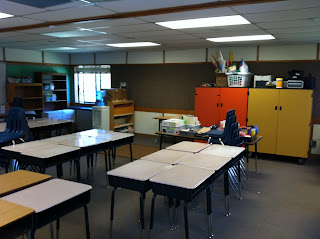
Below are a few pictures of the room. It is what you'd see looking in from the door, panning left to right. This is before getting things put away, but is a rough idea of what the space looks like. Lots of table space! There is a gap by the circle table in the first picture because that is where our netbook cart will be going (cart of 16- the other cart will be in the other portable). I am also relatively sure that my 3 groups of 6 will be trimmed since I likely won't have 30+ kids, and we don't have spare desks. Let me know what you think.


All of that said, once August hits I start to get restless. As much as I say I'd like to never work- running, reading, playing everyday instead- I end up starting to want to work. In the past 5 days I've gone into school for about 5 hours in order to do some room setup. I prefer to do that stuff without the hammer of the start of school hanging over me- many will do all setup during their first week back. I tend to need more space to get it done, freedom from folks interrupting or planning for the year. The planning tends to be my first week back stuff, a chance to really dig in without stressing about classroom environment.
This year I move out to a portable. I'm excited about the move, since previously I was in a shared space. This gives me more more wall space, as well as a lower ceiling and the ability to hang things from it (student work, etc). I think it is roughly the same square footage, if not slightly larger. In the end it will be nice. I'm unconcerned about the fact that it is outside of the building, therefore meaning we will lose a little bit of instructional time. Assuming I plan for it with my teammates, it shouldn't be a huge issue. Some of our swapping of kids could be challenging since that means lugging binders and notebooks around. But I think it will work out just fine after some initial adjustment.
Below are a few pictures of the room. It is what you'd see looking in from the door, panning left to right. This is before getting things put away, but is a rough idea of what the space looks like. Lots of table space! There is a gap by the circle table in the first picture because that is where our netbook cart will be going (cart of 16- the other cart will be in the other portable). I am also relatively sure that my 3 groups of 6 will be trimmed since I likely won't have 30+ kids, and we don't have spare desks. Let me know what you think.
Subscribe to:
Posts (Atom)