Monday, August 8, 2011

Bookstores, Beastologists, and the Internet

About two months ago, Borders Books and Music announced they were closing up shop. It seemed like a foregone conclusion to me because of how well their direct competitor, Barnes and Noble, has done (note: I worked at Borders in college and enjoyed it, likely owing my love of books to that job). That got me thinking: what would happen if all bookstores went by the wayside? Would shopping for kids books be the same if you just used your one-click Amazon.com shopping?

In the interest of full disclosure, I'll admit that I shop at a variety of book outlets. I hit Barnes and Noble to browse the new books, picking up books to see if my kids might like them. I head over the Ravenna Third Place Books for their mixture of new and used books. I get more bang for my buck there. Lastly, I shop Amazon when I am a little lazy and know what I want. Often that means buying more than I should because I want free shipping!

The Internet is a big part of the bookseller demise. I'll admit that Amazon is fantastic, and I can get virtually everything I'm looking for (not a guarantee at the other options). But I will seldom buy books there sight unseen. Why? My preference is to be able to flip through the book prior to purchase. While Amazon lets you read the first few pages, but sometimes you need to see if there are illustrations, or a variance in text later on (or chapter length etc).

That leads me to Nathaniel Fludd, Beastologist. I likely wouldn't have purchased this book without a trip to the bookstore. I saw it faced out at Barnes and Noble (as an aside, I saw recommendations for the book the Emerald Atlas on twitter, bringing about this trip). I thought the book looked slim on pages for my kiddos but the cover was intriguing. As I flipped through the text looked to appropriate and the writing was engaging. Since I was buying other books, I opted to bring this along. Great choice. It is approachable for kids in the middle grades, not overwhelming like some of the 200-300+ page books. It fits into that category of realistic fantasy without being too wordy. I'm excited I got it. It isn't a Newbery winner or contender, but a nice addition to the library. Hopefully neither of my brick and mortar bookstores will go under any time soon.


Sunday, August 7, 2011

Bird in a Box

Bird in a Box was another of the books I'd purchased for my Mock Newbery Project. The story was one that I ended up enjoying, but that took me some time to fall into. It is three separate but connected stories. Set in the 1930's, these three African American kids have seen more than most kids should have seen. Their stories are set against the backdrop of the famous boxer Joe Louis having his fights broadcast to radios across the country.

The three stories are engaging in their own right. Each chapter is a point in time, with a section for each child. Where I caught myself looking back into the book was in differentiating Willie from Otis. One has fled his abusive father, while the other had his parents pass away in a car accident. They become tied together through the orphanage they are living in. Following me? I know a few of my kids will be lost in the stories of each kid, later getting confused as they try to connect events to each character.

Overall I really enjoyed the story. You could feel the pain of each character, but also the hope that they held close to their hearts. I wonder if the story would have felt more cohesive if it expanded more on one character rather than having all three. All three were well done, but they seemed like vignettes at times. I certainly see this as a Newbery contender. One of my favorites of the summer.

Rating: 4.5 out of 5

Friday, August 5, 2011

Social Studies/Reading Notebooks

When I started two years ago my team was hoping we would integrate social studies and reading together. In effect, I'd teach a major of reading through the social studies content with some use of our reading textbook (as a supplement). At that time we had just adopted a new set of social studies materials, which conveniently came with a student journal. There were some elements of the journal, and I used them often, but there were quite a few pages I opted not to use for one reason or another.

This year we are going into our second year without the student journal that accompanies the material set. While we still have access to the pages (in pdf form), I've moved to tailoring my journals to the reading instruction I'm doing (the pages are more content based instead). Last year's experiment was largely successful. I would write questions aimed at strategies I was teaching, or at content I hoped kids to uncover. The questions were glued into student journals, and they'd respond below the question strip. This cut down on paper usage, but monitoring journals was a monster pain. Additionally this didn't account for any of the reading work (fiction/non-social studies) we were doing.

As I've been going through Guiding Readers I realized I need to better organize the student journals. The first full page is going to be their table of contents where we'll log each entry. I'll model this with my own journal under the document camera. A sample might look something like:


  • 9/19 p. 1 The Hunger Games response

  • 9/20 p. 1 Hunger Games response/S.S 1.2-3 Questions

  • 9/21 p. 2 Catching Fire response/S.S 1.3 Questions

With each day they will write a minimum of a few sentences about what they are reading. Beyond modelling this at the start of the year, I will also have a few options for students to chose from in writing about their book- summarize what they read, describe a character, analyze a character's actions, etc... Students will have choice over time, but we'll start with more structure and guidance as part of the gradual release process. To help the monitoring process I'll collect journals every week (or every third week since I have 3 groups... that part isn't fleshed out yet) to give feedback. I can look through journals to see what kids are saying, and how they are interpreting text. I might also have the journals as a way for kids to keep a record so that they can create a written response in our online blackboard-esque system at the end of the week (alleviating some of the legwork with journals on my end). This will also start to simulate more dialogue about books. The prospect of having a written dialogue is exciting for me, and one that I want to move in the direction of.

Thursday, August 4, 2011

Lack of Top Scores

As I've been perusing sites for Mock Newbery possibilities one thing has become apparent: people don't like giving out top ratings. No matter if the top end is 4 or 5, you seldom see it. Now it isn't to say that I am dishing out top scores left and right, but I couldn't help feeling a little angry. "Angry?," you say. Yep, angry. Why is that?

In the day and age of everyone getting stars and ribbons, I'm here to tell you the top score should be given out cautiously. Let's be frank: some books are better than others. This is obviously subjective, but I think we can agree that not all books are "great". Some books are ok for one reason or another- plot, storyline, character, author's voice, etc. Additionally, some books just aren't very good because of a similar set of characters as those that are ok but usually with more deficiencies. You can add onto that other issues like font and styling which are the publisher's work, not the author's, and play a big role in a book's perception. Would you bring every book into your classroom? I doubt it.

Now that we've established that there is a gradiant, my question is why do we see so few top end scores in reviews? Is it because there just aren't great books out there? To me both arguments fail to hold water. Great literature does come out every year (umm, the Newbery Award? various local awards like Sasquatch and Young Readers Choice?). The awards aren't foolproof, but they do often have a stringent criteria and aren't to be taken lightly.

Is it because we are comparing books to childhood favorites? I'm not comparing Okay For Now to Where the Red Fern Grows to see if I feel the same. Instead I need to assess the book based on some sort of written or unwritten criteria, and decide if it is great or worthy of that top end score. I use Okay For Now because it I felt like it was great. For a book set in the 1960s-70s to make someone not having lived through that era to make someone enter that world is incredible. The depth of character was fantastic, and the storyline kept you wanting to read on in a non-action story. I don't expect everyone to have the same feeling, but I can't help wondering why it is 4 out of 5 out 4.5 out of 5. That is the equivalent of saying it gets an 80% or 90%. Really? Not in that top percentile?

I don't expect every book to receive a top rating. But as I scroll through reviews I can't help but feel like people are holding unattainable standards. When you see 30+ books and they have 1 (or 2) that is top end, you start to question those doing the rating. The same can be said if all reach 5 stars- it just isn't likely!

The Trouble With May Amelia

Have you ever been reading a book that you were told was really good, but you were only passively interested in? That about sums up my experience with The Trouble With May Amelia by Jennifer Holm. The story is a sequel to Our Only May Amelia which was a Newbery Honor Award recipient in 2000. I found my experience with this story to be similar to my experience with The Penderwicks. I'll digress to that in a second.

The Trouble With May Amelia is one of the Mock Newbery recommended books for 2012. From those that I have seen on goodreads, and via various library blogs, this was to be a fantastic book. The storyline surrounds a girl named May Amelia Jackson who is growing up in Washington state at the turn of the 20th century. Her family is Finnish, and have settled in an unincorporated area on the Nasel River. This area is accessible only by boat, and the living is tough.

May Amelia's family struggles to get by with the work on the farm, and with many children (all 7 are boys except for May!). May Amelia fights for her place in her family, particularly as her father has proclaimed girls to be useless. The real trouble begins when a man comes to town looking for stakeholders in a company that plans to incorporate a town in this otherwise inaccessible area. The plans are to make this the Seattle to the south. It is then that the story really picks up, and you watch the growth of May Amelia and her family.

What I discovered through reading this story is rather simple: I struggle identifying with protagonists that are female. This was the same experience I had with the Penderwicks. I found myself wanting the main characters to stop needing to prove themselves as able or ready. The Penderwick girls were confident, but the story didn't give them enough assertiveness. I wanted them to act a bit more, which perhaps is another similarity in the stories (and might be another issue I have these types of stories). May Amelia proved herself to be more than able, but I wanted her to be more assertive. I stuck with it to see what would happen to May Amelia, and to see if she'd change.

Rating: 3 out of 5. Well written, aside from lack of quotation marks (my kiddos may be annoyed by this). Storyline was good but dragged. Last 60+ pages (last third) were well done.

Tuesday, August 2, 2011

Organizing My Week

I have yet to find an order to my week that is to my liking. That statement was true until earlier today. To digress, one area I have been looking to hone in is how I organize my reading instruction. Previously it has been a hodgepodge of social studies instruction, literature circles, and word study.

I've used the non-fiction in social studies as my vehicle for reading strategies, and it has worked out ok. Literature circles came about as I said "oh goodness (perhaps another nasty word substituted there) fiction is a gaping hole! how can that be?!" The literature circles were an attempt to get kids reading fiction in a more holistic manner, as the 5th grade reader only presents part of books... and how do you really understand what an author is doing when you don't see the beginning, middle, and end? Word study was another "oh goodness..." sort of remark, since word derivations are a 5th grade standard (get it, derived?! word study joke!).

Looking at Guiding Readers today, I came to the realization that I have a basic structure already in place. My challenge is sticking to it, and picking out the most important pieces. What does that structure look like?


  • Monday: Reader's Workshop- 5 to 10 minute mini-lesson; 50 minutes with guided reading groups, and including some reading response work towards the end.

  • Tuesday: Social Studies- content and strategy work; critical thinking and response; writing with some use of Units of Study

  • Wednesday: Word Work Wednesday- depends on the focus, but it has largely amounted to work with prefixes, suffixes, latin/greek roots, that sort of thing.

  • Thursday: Social Studies- content and strategy work; critical thinking and response; writing with some use of Units of Study

  • Friday: Social Studies- content and strategy work; critical thinking and response; writing with some use of Units of Study

Now in the Social Studies time the overall breakdown is 15 minutes of Independent/Guided Reading, and 40-45 minutes of content. That allows me to continue to work with readers and give them specific instruction tailored to their reading needs.


A few other things have become apparent. First is that I need to have kids organize their Social Studies journal. My plan is to use is as a reading/social studies journal, with kids keeping track of their work in a table of contents. This is already done in science, so it will be a continuation of that practice. I'll also be able to track their progress with kids leaving their journals for me to check periodically. The second piece is that I will need to be flexible in my use of that Friday time, allowing for kids to meet face to face with their literature circle group. I hope to pair this with the online component where they'll be blogging and message boarding. Organization will be key, particularly for me. The earlier I hone my process for the kids, the smoother this will go. The end should be more strategic instruction, and increased learning... or so I hope.

Monday, August 1, 2011

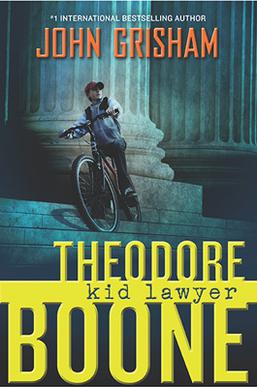
Theodore Boone... Grisham's Foray Into KidLit

I was never much of a John Grisham fan. In fact, I'm not a huge law person. I like laws, and the order that they can create, but I'm not overwhelmed by their intricacies. It should come as no surprise that I wasn't jumping at the first chance to purchase Theodore Boone, Kid Lawyer when it first came out a year or so ago. Seeing it in paperback made for a far more appealing and cost effective purchase.

To be brief: Theodore Boone is the only son of two lawyers, living in a mid-sized city (I think it said 75k people or so- more on that later). He loves the law and wants to be a lawyer. Kids in town ask him for help, and he happens to know about all of those associated with the law in his town. When the first murder in 50+ years happens, everyone is fascinated by the case, Theo included.

The story takes a variety of twists and turns, and doesn't necessarily finish up in the end. Of course it is left open for a second story, which you get the first 3 pages of at the end (Theodore Boone, the Abduction). This first story felt more like an introduction than a full blown story. You learn about Theo, his family, the major case, and the big players in the legal field in town. But you really aren't brought from beginning to end like many stories.

I have 2 other issues with the story: the first is Theo as a character, and the second is the setting. Obviously those are two major issues! Theo is only in middle school (or junior high), yet his legal prowess seems very advanced. I think many of my students would question the plausibility of this fella! His access to legal areas, and his overall knowledge of the legal field were far and away beyond any typical kid. It isn't that all kids need to be normal or average, but you do need to be able to identify with them... he seemed a tad more adult than most. The setting is a gripe for me, but perhaps not for my kiddos. In size, it is like many of the towns/cities surrounding Seattle... except larger (by about 25k). The old time feel of the town simply doesn't jive. To me that is more an issue with getting your facts straight. But... you need to be able to believe the author to believe the story as it progresses, which is why it is an issue.

Rating: 2 of 5. Not a bad first go at children's books for Grisham, but left quite a bit to be desired from the prolific adult writing.